
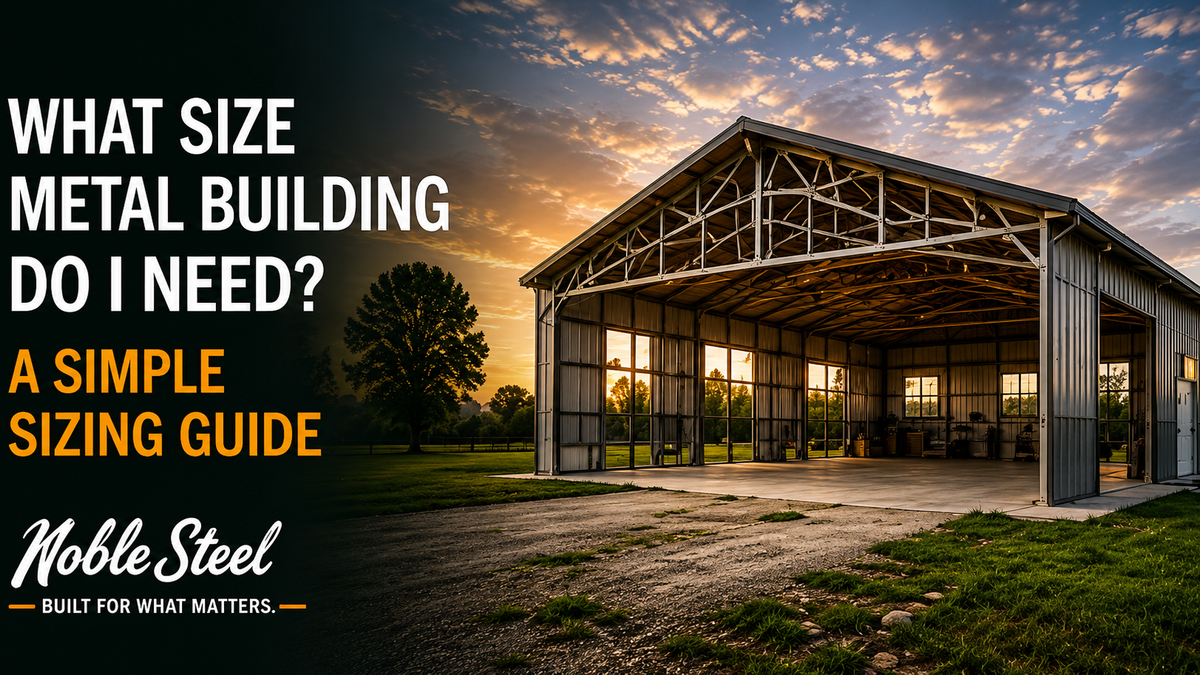
Most buyers undersize their metal building. They measure what they have today, not what they'll need in two years — and then they call us frustrated, standing in a building they already outgrew. Getti...
What Size Metal Building Do I Need? A Simple Sizing Guide
Most buyers undersize their metal building. They measure what they have today, not what they'll need in two years — and then they call us frustrated, standing in a building they already outgrew. Getting the size right before you order is the single most important decision you'll make.
This guide will walk you through exactly how to calculate what you need, what the most common size matchups look like in the real world, and how to make a decision you'll still be happy with years from now.
The #1 Mistake Buyers Make: Sizing for Today
It's natural. You look at your two trucks, your riding mower, and a stack of equipment — you measure the footprint, maybe add a few feet, and call it a day.
The problem is you're not accounting for how you actually use space. You need room to open doors. You need room to walk around the vehicle. You need somewhere to put the things you're working on. And you almost certainly have more stuff coming.
A building that fits your stuff is not the same as a building you can work in.
The fix is simple: whatever footage you calculate from what you plan to store, add 20 to 30 percent. That buffer covers clearances, workflow, and the reality that your needs will grow.
Start With What You're Putting Inside
Before you think about dimensions, list exactly what's going in. Be specific.
Vehicles:Standard pickup trucks run about 19–22 feet long and 7–8 feet wide. Full-size SUVs are similar. If you're parking an F-350 crew cab with a long bed, you're looking at 22–23 feet of length. RVs and fifth wheels can push 30–40 feet. Know your largest vehicle — and leave at least 3 feet on each side and front for doors, walking, and not dinged paint.
Equipment:Tractors, skid steers, zero-turn mowers — these are wide and often need room to maneuver, not just sit. A mid-size tractor with a loader can be 10 feet wide and need more than that to turn around inside.
Workspace:A workbench takes up linear wall space. If you want a dedicated mechanic's area, a welding station, or a woodworking corner, that's square footage that isn't available for storage.
Future additions:Think about where you'll be in 3–5 years. More equipment? A side-by-side? A second truck? Better to build it now than wish you had.
Once you've listed everything, estimate the total square footage it would occupy if laid out flat — and then apply that 20–30% buffer before you pick a building size.
Clearance Heights Matter as Much as Footprints
Don't forget the vertical dimension. Standard metal buildings come with a 10-foot or 12-foot eave height, which works for most trucks and recreational vehicles. But if you're storing:
- A lifted truck or large SUV — you may need 12–14 feet
- An RV or fifth wheel — clearance of 13–16 feet is often necessary
- Farm equipment with raised attachments — height can vary, but 14+ feet is safer
- Commercial vehicles or box trucks — plan for at least 14 feet
The door height matters just as much as the eave height. If you need a 14-foot opening, that affects which doors you can spec and what the overall building height needs to be. Figure out your largest door requirement early — it shapes the whole structure.
Common Size Matchups That Actually Work
Here's how the most common building sizes map to real-world uses. These aren't arbitrary — they reflect what our customers actually need once they think through clearances and workflow.
24x36 — Two-Car Garage
Two standard vehicles side by side, room to open doors and walk around, space for a small workbench along the back wall. Tighter than most people expect, but workable for a clean two-car setup with minimal equipment storage.
30x40 — Workshop or Three-Car Garage
This is one of the most popular sizes we sell. It's roomy enough for three vehicles in a pinch, two vehicles plus serious workshop space, or one large vehicle plus equipment and a full work area. The extra 10 feet of width makes a significant difference in how the space feels and functions.
40x60 — Large Shop or Multi-Use Building
Two to three vehicles with dedicated workshop space, or a small commercial operation. This size gives you room to actually work — lay out a project, have tools accessible, move equipment without playing Tetris. If you're running a side business out of your shop, this is usually the floor where you want to start.
50x100 — Commercial or Agricultural
Full commercial operations, large equipment storage, multi-bay setups. Common for contractors, farmers, and small businesses that need serious square footage. At this scale, door placement and interior layout planning becomes especially important — get those decisions right before you order.
Anything Larger:
Custom dimensions are available. If your needs don't fit a standard size, we can work with you on a custom quote. There's no rule that says your building has to be a standard size.
The Building You Grow Into vs. The One You Outgrow in Two Years
This is the conversation we have with almost every customer who calls back after their first building gets too small.
Here's the honest math: going from a 30x40 to a 40x60 adds 800 square feet. The cost difference is real, but it's a fraction of what it would cost to pour a new slab and buy another building two years from now. The foundation, site prep, permits, and delivery costs don't go away the second time — you pay them again.
We're not saying buy more building than you need. We're saying: be honest with yourself about where you're headed, not just where you are.
If you're on the fence between two sizes, almost every customer who has been through this process will tell you the same thing: go bigger.
A Practical Decision Framework
When a customer calls us to talk through sizing, here's roughly how the conversation goes:
1. What's the single largest thing going in?
This sets your minimum clearance height and your minimum interior dimension. Everything else fits around it.
2. How many vehicles or pieces of equipment total?
Count them, measure the largest ones, and assume you'll add one more in the next few years.
3. How much active workspace do you need?
Passive storage is different from active workspace. If you're working in this building — wrenching on vehicles, building things, running a business — you need significantly more square footage than if you're just parking.
4. Where does the door go?
Door placement drives how usable the building is. A door in the wrong spot can cut your usable space significantly. Think about how you'll actually move in and out before you lock in the footprint.
5. Any future additions?
Lean-tos, walled-in sections, expanded footprints — metal buildings can be expanded, but it's cheaper and easier to get the right size the first time.
One More Thing: Don't Forget the Outside
The building footprint isn't the only thing on your property. You need clearance for doors to swing or roll, room for the delivery truck to maneuver, setbacks from property lines (your local jurisdiction will have rules on this), and practical access for whatever's going in and out.
If you're putting a 40x60 building on a half-acre lot with trees on two sides and a fence on the third, the access situation matters. Think through the whole site, not just the pad dimensions.
We'll Help You Get This Right
Sizing a metal building isn't complicated, but it's easy to get wrong when you're doing it for the first time. We've helped thousands of customers through this process, and we've seen every mistake in the book — including the ones that cost real money to fix.
If you're not sure what size you need, we'll walk through it with you. Tell us what you're storing, how you plan to use the space, and where you're headed in the next few years. We'll tell you what we'd buy if it were our building — and if we think you're headed toward a size that won't serve you, we'll say so.
Don't forget to ask about seasonal discounts.Noble Steel runs price promotions at certain points during the year. If you're close to a buying decision, it's worth asking whether a discount window is currently open — we'll tell you straight. These windows close, and there's no going back once they do.
Ready to get a real quote? Talk to Noble Steel — we'll help you find the right building or talk you out of the wrong one.