
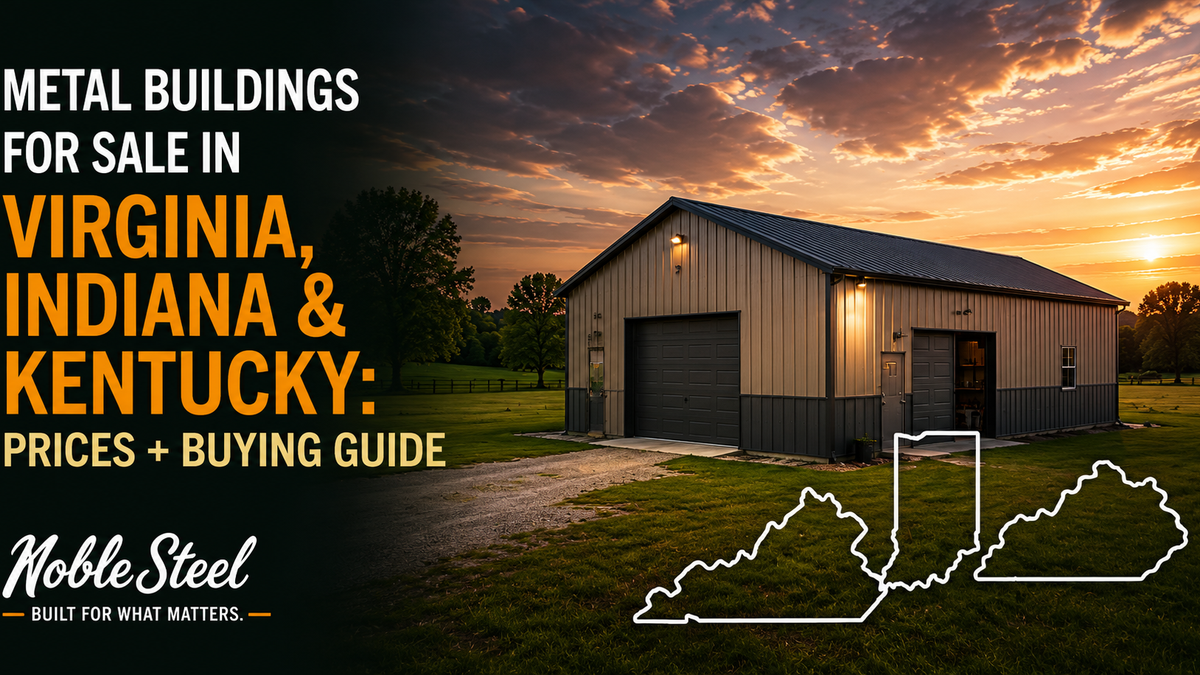
Virginia, Indiana, and Kentucky don't get lumped together often. But if you're buying a metal building in any of these three states in 2026, you're dealing with the same core reality: a permit landsca...
Metal Buildings for Sale in Virginia, Indiana & Kentucky: Buyer's Guide 2026
Virginia, Indiana, and Kentucky don't get lumped together often. But if you're buying a metal building in any of these three states in 2026, you're dealing with the same core reality: a permit landscape that varies wildly by county, weather requirements that catch buyers off guard, and a market full of quotes that look similar until you read the fine print. This guide breaks down what you need to know in each state — and what to ask before you sign anything.
Virginia: Mountain Terrain, Strict Codes, and a Market Buyers Underestimate
The Virginia Metal Building Market
Virginia's metal building market is split almost perfectly between its two geographic identities: the dense, fast-growing suburban corridor from Northern Virginia through Richmond, and the rural agricultural communities of the Shenandoah Valley, Southside, and Southwest Virginia.
In the suburbs, metal buildings serve commercial and light industrial uses — contractor shops, warehouses, self-storage facilities, and flex spaces in the growing exurbs of Loudoun, Fauquier, and Culpeper counties. In rural Virginia, the demand is agricultural and residential — horse barns, equipment storage, hay and feed facilities, and residential garages for properties with acreage.
Weather and Load Ratings in Virginia
Virginia's geography creates genuine variation in engineering requirements.
Snow load:Southwest Virginia — particularly the mountainous counties of Grayson, Smyth, Highland, and Bath — can see significant snowfall and carries ground snow load requirements of 30–40 psf or more at elevation. The Valley and Ridge region of the Shenandoah Valley sits at 20–30 psf. Northern Virginia and the Coastal Plain are lower, typically 15–25 psf. This variation matters. A building quoted for Richmond spec is not the right building for a site at 3,000 feet elevation in Grayson County.
Wind load:Most of Virginia falls in the 90–115 mph design wind zone. Coastal areas (Eastern Shore, Virginia Beach corridor) see higher wind exposure and may require coastal-rated construction.
Seismic consideration:Virginia has an active, if moderate, seismic zone. The 2011 Mineral earthquake was a reminder that seismic provisions in Virginia's building code are real. Larger commercial buildings should confirm that the engineered drawings account for Virginia's seismic design category.
Permit Basics in Virginia
Virginia enforces the Virginia Uniform Statewide Building Code (USBC), which applies in all jurisdictions — Virginia has no unincorporated areas with zero code enforcement, unlike some other states. Every county and city has a building official and requires permits for permanent structures.
What this means for you: engineered stamped drawings are essentially mandatory for a permitted metal building in Virginia. You will need a site plan showing setbacks, and most localities require inspections at multiple stages. Plan for 6–12 weeks for permit review in active jurisdictions; rural counties are often faster.
Agricultural structures may qualify for a limited exemption under Virginia's agricultural building definition, but the structure must meet the definition strictly — used for agricultural production, not residential accessory use. Confirm with your local building official before assuming the exemption applies.
Popular Sizes in Virginia
Indiana: Flat Land, Heavy Snow Zones, and a Strong Agricultural Base
The Indiana Metal Building Market
Indiana is quietly one of the stronger metal building markets in the Midwest. The state's flat agricultural landscape — particularly in the northern two-thirds — creates consistent demand for grain storage, equipment barns, livestock facilities, and large-scale agricultural structures. Add a growing light industrial corridor along I-65 and I-70, and you have a market with both rural and commercial depth.
Residential use is also strong in Indiana. Suburban buyers in the Indianapolis metro, Fort Wayne, South Bend, and Evansville regularly build residential garages, home workshops, and RV storage buildings on their properties.
Weather and Load Ratings in Indiana
Snow load:Indiana's northern counties — Lake, Porter, LaPorte, St. Joseph, Elkhart — are in a lake-effect snow zone influenced by Lake Michigan. Ground snow loads in these counties can reach 25–30 psf, and the lake-effect events that dump a foot of snow in 12 hours are a real structural consideration. Central and Southern Indiana are lower — typically 15–20 psf.
Any Indiana buyer should know their county's ground snow load before they accept a quote. This number should be in the engineering specs of any building you purchase.
Wind load:Indiana sits in a moderate wind zone, generally 90–100 mph. However, the state has a documented history of significant tornado events, particularly in the western and central regions. While metal buildings aren't designed specifically to resist a direct tornado hit, a properly engineered structure in the right wind zone will perform better than an underbuilt one.
Permit Basics in Indiana
Indiana's permitting landscape is less uniform than Virginia's. The state has a statewide building code (Indiana Building Code, based on the IBC), but enforcement is managed at the local level — and not every county actively enforces it.
Township and rural areas:Many rural Indiana townships and smaller counties have limited enforcement capacity. Some buyers in rural Indiana counties build without a permit on agricultural properties with minimal friction. That said, always confirm with the county directly — and be aware that even in low-enforcement areas, your insurance company may have its own requirements for documented engineered structures.
Cities and larger counties:Indianapolis (Marion County), Fort Wayne (Allen County), South Bend (St. Joseph County), and similar metro areas have active building departments with full plan review and inspection requirements. Engineered drawings are standard.
Agricultural exemptions:Indiana, like many Midwestern states, has agricultural structure exemptions that may reduce permit requirements for qualifying farm buildings. Your county assessor's classification of the property as agricultural determines whether this applies.
Popular Sizes in Indiana
Kentucky: The Bluegrass State's Quiet Metal Building Surge
The Kentucky Metal Building Market
Kentucky doesn't make national headlines, but it's a solid and growing market for metal buildings. The state's mix of horse farms, tobacco operations (increasingly transitioning to other agricultural uses), a busy highway system that drives commercial warehousing, and a large rural residential population all create sustained demand.
Louisville and Lexington drive commercial demand. The rural counties — Eastern Kentucky, Western Kentucky coal country, the Pennyrile region — have strong residential and agricultural demand. Horse properties in the Bluegrass region (Fayette, Bourbon, Scott, Woodford counties) are a specific niche where well-configured horse barns and equipment facilities are in consistent demand.
Weather and Load Ratings in Kentucky
Snow load:Kentucky spans a notable range. Western Kentucky (Paducah, Hopkinsville) has lower snow loads — 10–15 psf. Central and Eastern Kentucky step up — Lexington and the Bluegrass are in the 20 psf range. Eastern Kentucky mountains can approach 25–30 psf in the higher elevations of the Appalachian Plateau. If you're building in Pike, Letcher, or Harlan County, confirm your county's design snow load.
Wind load:Kentucky sits in the 90–110 mph design wind zone. Western Kentucky is at higher risk for significant tornado activity — the state has seen major tornado outbreaks, including the December 2021 event that devastated parts of Western Kentucky. While no building is tornado-proof, a properly engineered structure holds up far better than an underbuilt one.
Permit Basics in Kentucky
Kentucky uses the Kentucky Building Code (KBC) as its statewide standard, with local enforcement. The state's rural counties vary significantly in how actively permits are required and enforced.
Rural counties:In many rural Kentucky counties, agricultural structures face limited or no permit requirements. The definition of "agricultural" is broadly applied in much of the state. Confirm with your county judge-executive's office or county building inspector.
Urban and suburban areas:Louisville (Jefferson County), Lexington (Fayette County — a unified urban county government), Bowling Green, and Covington all have active permitting requirements. Engineered drawings, site plans, and inspections are standard for any permitted structure.
Horse farms and equine facilities:Kentucky has specific provisions and familiarity with equine-related agricultural structures. If you're building a horse barn on an ag-designated property, the agricultural exemption is commonly available and commonly applied.
Popular Sizes in Kentucky
What Ties Virginia, Indiana, and Kentucky Together
These three states represent a significant portion of Noble Steel's service footprint in the mid-Atlantic and Midwest, and they share a common theme: local conditions matter more than buyers expect.
Snow loads vary from county to county. Permit requirements vary from township to township. The same building quote that works for a rural farm property in Western Kentucky may be completely wrong for a commercial warehouse in suburban Indianapolis. A good metal building company knows the difference — and builds the engineering to match your specific site, not a generic mid-continent spec.
At Noble Steel, we cover all three states and we're not going to hand you a quote that ignores your local requirements. If you don't know your county's design snow load, we'll look it up. If you need engineered drawings for your jurisdiction, those are part of the package.
Ready to get a real quote? Talk to Noble Steel — we'll help you find the right building or talk you out of the wrong one.