
Texas is the largest metal building market in the United States. That's not a guess — it's reflected in every production report the steel building industry puts out. And yet, a huge percentage of Texa...
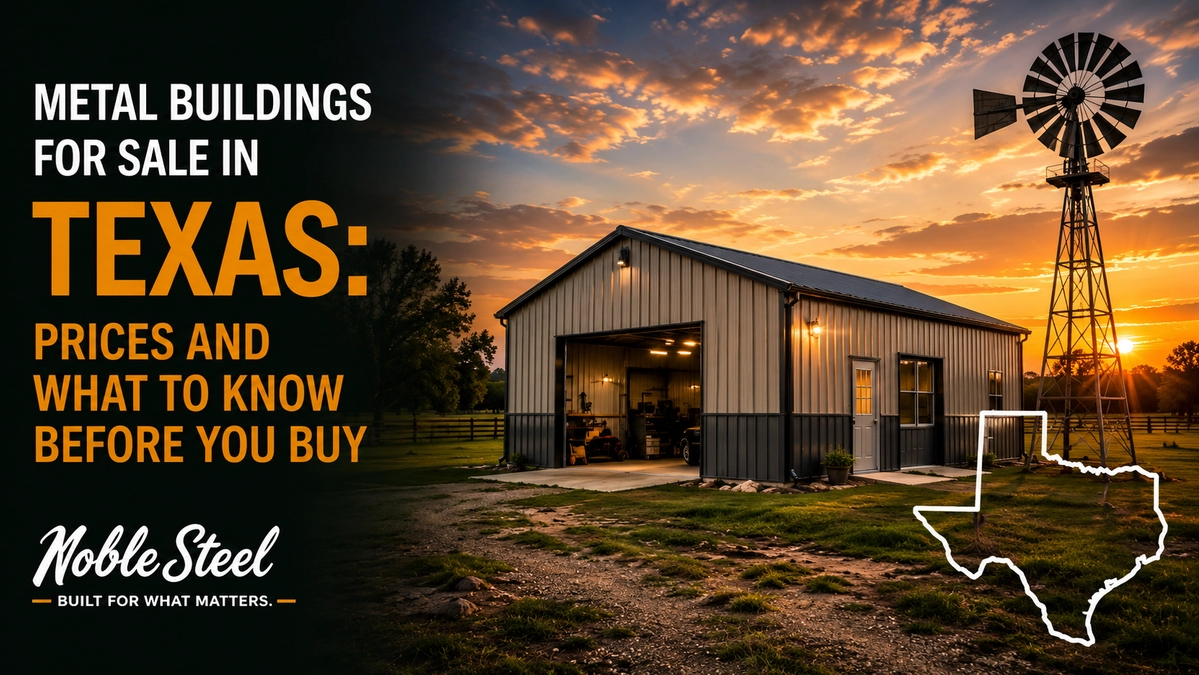
Metal Buildings for Sale in Texas: Prices and What to Know 2026
Texas is the largest metal building market in the United States. That's not a guess — it's reflected in every production report the steel building industry puts out. And yet, a huge percentage of Texas buyers still get burned by companies that don't account for Texas-specific engineering requirements, skip the permit conversation, or sell a building that's undersized for the job. Here's what you actually need to know.
Why Texas Dominates the Metal Building Market
Texas is big in every way that matters for this industry: massive agricultural operations, sprawling commercial development, a housing boom driving demand for residential garages and shops, and hundreds of thousands of acres of rural land where metal buildings are the obvious answer.
The numbers back it up. Texas consistently accounts for more metal building deliveries than any other state. The reasons are straightforward:
- Land availability:Texas has more private rural land than almost anywhere in the country. Metal buildings are the default structure for ag operations, hunting ranches, and rural residential properties.
- Commercial growth:DFW, Houston, San Antonio, and Austin are among the fastest-growing metro areas in the US. Warehouses, flex spaces, and commercial shops are in constant demand.
- Cost advantage over traditional construction:In a state with high construction labor costs in the metros, metal buildings offer a 30–50% savings over wood-frame or tilt-wall for the same square footage.
- Speed:A metal building can be delivered and erected in weeks. In a market where time is money, that matters.
Texas Weather and Load Ratings: The Part Most Companies Skip
This is where buyers get into trouble.
Texas is not one climate. It's five or six, and each has different engineering requirements for your building.
Wind load — the most critical factor in Texas:
- Gulf Coast (Houston, Corpus Christi, Beaumont):This is a high-wind zone. Buildings here need to be engineered for 130–150 mph wind speeds due to hurricane exposure. If a company quotes you a standard 90 mph building for a Gulf Coast site, walk away. The structural difference is not cosmetic — it's the difference between a building that survives a storm and one that doesn't.
- Tornado Alley (North Texas, Panhandle, parts of Central TX):West Texas and the Panhandle see some of the most extreme tornado risk in the country. While no metal building is tornado-proof, a properly engineered building in the correct wind zone will perform significantly better than an underbuilt one.
- Central and Hill Country:115 mph is a common design threshold here. Still not a standard residential spec.
Snow load:Most of Texas has minimal snow load requirements — typically 0–5 psf. The exception is the Panhandle and far West Texas (Amarillo, Lubbock areas), where heavier snow events can occur. Not a primary concern for most of the state, but worth confirming if you're in the northern tier.
Soil conditions:Texas has some of the most expansive clay soil in the country, particularly in North Texas and the Blackland Prairie region. This directly affects your foundation design and can cause problems for poorly anchored buildings. A geotechnical assessment before you pour your slab is money well spent.
The bottom line: always ask what wind zone your specific county falls in and what the building is engineered to. Get it in writing.
What Metal Buildings Cost in Texas in 2026
Texas pricing reflects the scale of the market — there are more companies competing here than anywhere else, which can be good or bad depending on who you're talking to. Good because prices are competitive. Bad because there are also more low-ball quotes designed to get you signed before the caveats come out.
Realistic 2026 pricing in Texas:
- Residential garage / small shop (24x30 to 30x40):$13,000–$24,000 installed
- Medium farm shop or contractor's building (40x60 to 50x80):$30,000–$60,000 installed
- Commercial warehouse or large ag building (60x100+):$65,000–$130,000+ installed
Add engineered drawings, insulation, overhead doors, walk doors, windows, and coastal wind upgrades and the number moves accordingly. Anyone quoting you a 50x80 commercial-grade shop for $18,000 is selling you something — just not what you think.
Permit Basics in Texas
Texas has a decentralized permitting landscape, and this is one of the biggest sources of confusion for first-time metal building buyers.
Unincorporated counties — the wide-open zones:Many rural Texas counties, particularly in West Texas, have no local building codes and no permit requirements for agricultural or residential structures. If you're building outside city limits in Reeves County, Loving County, or most of the Panhandle counties, you may be able to build without a permit. Confirm directly with the county judge's office or county engineer before assuming.
Incorporated cities and their ETJs:If you're inside city limits — or within the city's extraterritorial jurisdiction (ETJ), which can extend several miles outside city boundaries — you'll likely face full permit requirements. Houston, Dallas, Fort Worth, San Antonio, Austin, and their surrounding suburbs all have active building departments with plan review and inspection requirements.
Agricultural exemptions:Texas offers agricultural exemptions on property taxes and, in some jurisdictions, on building permit requirements for structures used in an agricultural operation. If your building qualifies, this can simplify the process significantly. Your county appraisal district can confirm if your property has an ag exemption.
What you'll typically need for a permitted build:Engineered stamped drawings (required for most commercial and many residential permits), site plan showing setbacks, and sometimes a soils report. A reputable company handles the engineering documentation — that's non-negotiable.
Popular Sizes for Texas Buyers
Texas buyers tend to go bigger. The land is there, the use cases are large-scale, and the marginal cost per square foot drops as you scale up.
Eave height matters especially in Texas. Ag buildings storing combines, cotton strippers, or large implements routinely need 16–20 foot eaves. Commercial buildings often start at 14 feet and go up from there.
Noble Steel's Service Area in Texas
Noble Steel serves buyers across the state — from the Houston metro and the Gulf Coast to DFW, the Hill Country, and the Permian Basin. We know the load requirements that vary by region, we know the permit landscape across major Texas counties, and we're not going to quote you a Gulf Coast building at a Central Texas wind rating.
If you're not sure what size or configuration fits your property, we'll work through it with you. If the building you've been quoted by someone else doesn't match what you described you need, we'll tell you why.
What to Ask Any Metal Building Company
1.What wind speed is this building engineered for, and does that match my county's requirement?Non-negotiable question.
2.Is this building certified for the Texas Department of Insurance wind zone if I'm on the Gulf Coast?
3.Does the price include engineered stamped drawings?
4.What's the steel gauge on the frame and panels?
5.What's excluded from this quote?(Slab, site prep, permits, doors, insulation — know what you're actually getting.)
Ready to get a real quote? Talk to Noble Steel — we'll help you find the right building or talk you out of the wrong one.