
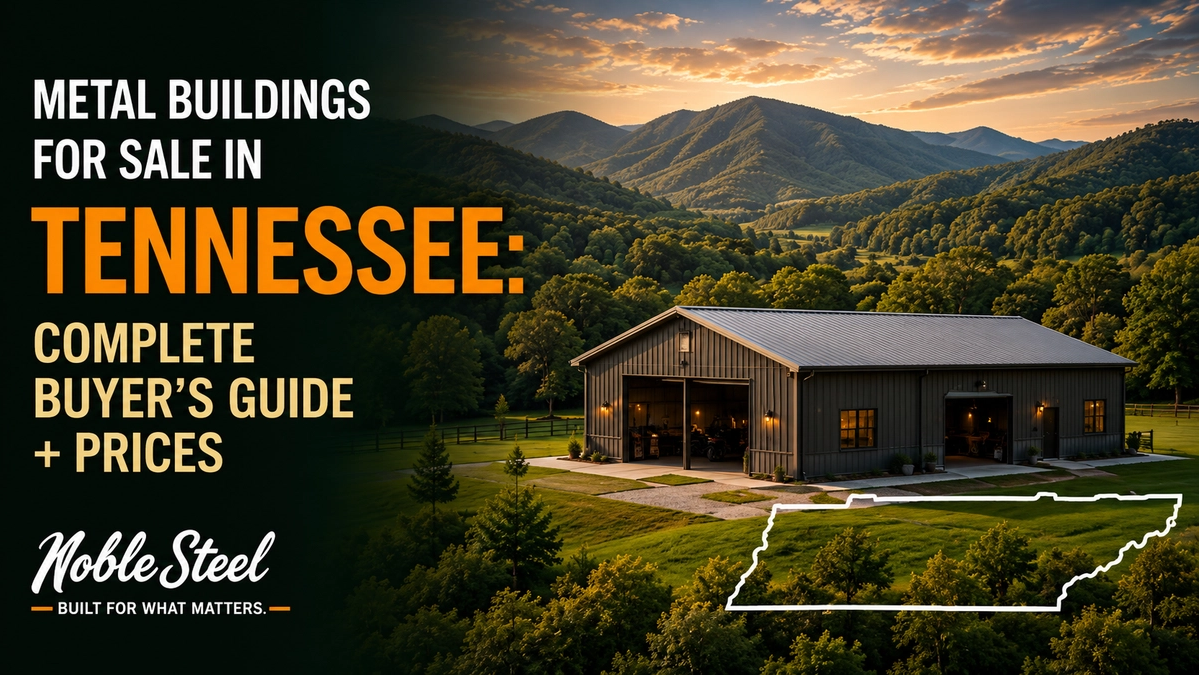
Tennessee is one of the fastest-growing metal building markets in the Southeast — and most buyers have no idea what they're walking into. Permits, load ratings, county rules, site prep — these aren't ...
Metal Buildings for Sale in Tennessee: Complete Buyer's Guide 2026
Tennessee is one of the fastest-growing metal building markets in the Southeast — and most buyers have no idea what they're walking into. Permits, load ratings, county rules, site prep — these aren't small details. Get them wrong and you're staring at a building you can't legally occupy. This guide tells you what other companies pitching you won't.
Why Tennessee Buyers Are Turning to Metal Buildings
Tennessee's mix of rural land, growing suburbs, and a booming agricultural economy makes it an ideal environment for metal buildings. The state has seen a surge of demand from:
- Farmers and hobby farmersin Middle and East Tennessee who need equipment storage, hay barns, and livestock shelters
- Homeownersacross suburbs like Murfreesboro, Smyrna, and Spring Hill who want residential garages, shops, or extra storage outside the HOA's reach
- Small business owners and contractorswho need commercial shops, warehouses, and flex spaces without the price tag of traditional construction
- Recreational property ownersin the Smokies and Highland Rim who want hunting cabins, equipment sheds, or multi-purpose outbuildings
Steel beats wood on price, speed, and durability in almost every one of these use cases. A metal building in Tennessee can go up in days, not months — and it won't rot, warp, or welcome termites.
What Metal Buildings Cost in Tennessee
Pricing varies based on size, configuration, and what you actually need the building to do. Here's a realistic ballpark for 2026:
- Small residential garage (24x30 to 30x40):$12,000–$22,000 installed
- Mid-size farm shop or workshop (40x60 to 50x80):$28,000–$55,000 installed
- Large commercial or agricultural building (60x100+):$60,000–$120,000+ depending on options
These numbers assume standard steel framing, standard gauge panels, basic trim, and a concrete slab that you've handled separately. Add engineered drawings, insulation, windows, walk doors, and roll-up doors and you'll adjust the number up. Anyone quoting you dramatically lower is probably leaving something out.
Tennessee Weather and Load Ratings: What You Actually Need
Tennessee isn't a state you can treat as one climate zone. Here's what matters:
Wind load:Most of Tennessee falls in the 90–115 mph wind zone. East Tennessee — particularly in valleys that channel wind — can see higher gusts. If you're in a county that borders the Appalachians or sits in a known storm corridor, ask explicitly what wind speed the building is engineered to. Don't assume. A standard residential-grade building may not be sufficient.
Snow load:West Tennessee (Memphis area) sees minimal snow. But East Tennessee and the Cumberland Plateau can see 15–25+ inches in a heavy winter. Buildings in these regions need to be engineered for ground snow loads of 15–20 psf (pounds per square foot) minimum. The Smoky Mountains and surrounding counties may require more. If your building is going at elevation — say, above 2,000 feet — confirm the snow load rating before you sign anything.
Soil and drainage:Tennessee's red clay soil in Middle Tennessee and rocky terrain in East Tennessee both affect your foundation and drainage requirements. A proper site evaluation isn't optional — it's the foundation for everything that comes after (literally).
Permit Basics in Tennessee
Here's the honest answer: it depends on where you're building.
Tennessee doesn't have a statewide unified permitting system for metal buildings. Each county and city handles this differently.
- Unincorporated rural counties:Many rural Tennessee counties have no local building codes — particularly in West Tennessee. If you're outside city limits in Gibson, Weakley, or Carroll County, you may not need a permit at all for an agricultural structure. But verify this with the county directly before you assume.
- Incorporated cities and growing suburbs:If you're in Nashville, Knoxville, Chattanooga, or any of their surrounding suburbs (Brentwood, Franklin, Hendersonville, Maryville), expect full permit review, engineered drawings, and inspections. Turnaround on permits in high-growth counties like Williamson and Rutherford can take 6–12 weeks.
- Residential vs. commercial use:Agricultural-use buildings and residential accessory structures often fall under different rules than commercial buildings. Make sure you're classifying the structure correctly when you apply.
A good metal building company will help you understand what documentation you need — engineered drawings, load calculations, site plans — and make sure the building they sell you is engineered to meet local code. If a company hands you a generic quote without mentioning permits, that's a flag.
Popular Sizes for Tennessee Buyers
The most common configurations we see ordered for Tennessee properties:
Eave height is just as important as footprint. If you're storing a tractor with a cab, a hay elevator, or a lift, a standard 10-foot eave won't cut it. Most farm shops we configure for Tennessee buyers go 12–14 foot eave minimum.
Noble Steel's Service Area in Tennessee
Noble Steel serves buyers across Tennessee — from the Memphis metro to Knoxville, from Nashville and its suburbs to rural West Tennessee farm country. We work with local site contractors and can help you think through site prep, foundation, and any permit documentation your county requires.
We don't just sell you a kit and walk away. If a 40x60 isn't right for what you described, we'll tell you. If your county's snow load requirement means you need a heavier gauge than you budgeted for, we'll show you what that actually costs rather than let you find out after the fact.
What to Ask Any Metal Building Company
Before you commit to a quote, get clear answers on these:
1.Is this building engineered for Tennessee-specific wind and snow loads?Get the psf numbers in writing.
2.Does the price include engineered stamped drawings?Most counties with permit requirements need them.
3.What's the panel gauge and frame size?Heavier is not always more expensive when you're comparing apples to apples.
4.What does installation include?Anchor bolts, trim, doors — confirm what's in and what's not.
5.What's your lead time?In 2026, most reputable companies are 8–14 weeks out from order to delivery.
Ready to get a real quote? Talk to Noble Steel — we'll help you find the right building or talk you out of the wrong one.