
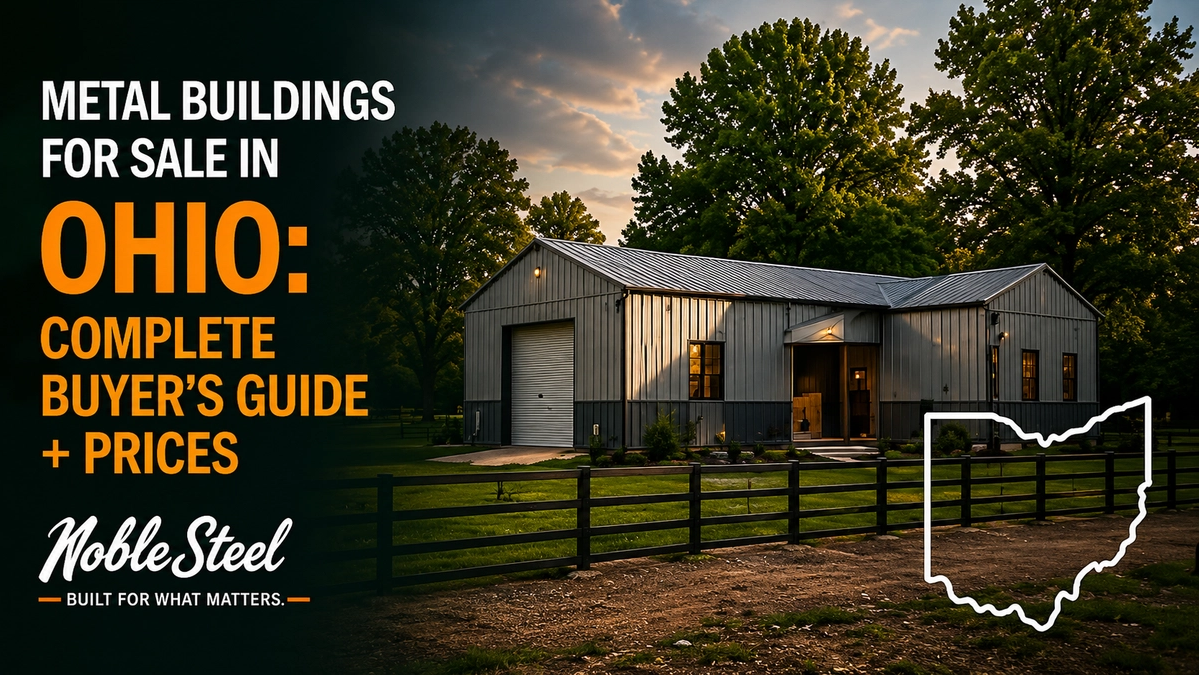
Ohio buyers often don't realize how much the location of their property — whether it's near Lake Erie or in the rolling hills of Southeast Ohio — affects what kind of metal building they actually need...
Metal Buildings for Sale in Ohio: Complete Buyer's Guide 2026
Ohio buyers often don't realize how much the location of their property — whether it's near Lake Erie or in the rolling hills of Southeast Ohio — affects what kind of metal building they actually need. A building quoted for Columbus doesn't necessarily meet the engineering requirements for a site in Ashtabula County. This guide explains what matters and what to look for before you buy.
Why Metal Buildings Make Sense in Ohio
Ohio has a strong mix of agricultural land, growing commercial corridors, and suburban residential expansion that makes metal buildings a natural fit across the state.
Agricultural useremains the largest driver in rural Ohio. Counties in the northwest — Defiance, Paulding, Henry, Putnam — are among the most productive farmland in the Midwest, and grain storage, equipment barns, and livestock facilities are in constant demand. Steel outperforms wood for all of these applications on longevity, maintenance cost, and resistance to pests and moisture.
Residential and hobby-farm useis growing in the suburbs surrounding Columbus, Cincinnati, Dayton, and Cleveland. Homeowners with acreage want workshops, three-car garages, RV storage, and multi-purpose outbuildings. Metal buildings deliver faster and at lower cost than stick-frame alternatives for these applications.
Commercial and industrial useis significant in Ohio's manufacturing corridor. Steel buildings serve as warehouses, flex spaces, contractor shops, and light manufacturing facilities for businesses that don't want to lease and can't justify tilt-wall construction.
Ohio Weather and Load Ratings: Snow Is the Real Concern
Ohio gets underestimated as a weather state. It isn't Texas or Florida, but it has meaningful engineering requirements — particularly for snow.
Snow load — the most important factor in Ohio:
Ohio sits in a northern climate with substantial snowfall in many regions. The state's ground snow load requirements range from about 20 psf in Southern Ohio to 30 psf or more in Northern Ohio near Lake Erie. The Lake Erie snowbelt — a narrow band covering counties like Lake, Geauga, Ashtabula, Erie, and Lorain — is among the snowiest regions east of the Rockies. Ashtabula County, for example, regularly sees 100+ inches of snow per year due to lake-effect events.
If your building is going up in Northeast Ohio and it isn't engineered for the correct snow load, you're taking on real structural risk. A good company will pull the correct ground snow load map value for your county and build that into the engineering. A bad one will quote you a Sun Belt-spec building at a Sun Belt price.
Wind load:Most of Ohio falls in the 90–100 mph design wind speed range. Not as dramatic as Gulf Coast states, but still worth confirming for your specific site. Open agricultural sites with no wind break can see higher effective loads even in a moderate wind zone.
Frost depth:Ohio's frost depth averages 30–36 inches, which affects your foundation design. Anchor bolts and column footings need to go below frost line. This is a site prep detail that affects both your foundation contractor and your building configuration.
Permit Basics in Ohio
Ohio has a statewide building code administered through the Ohio Building Code (OBC), but enforcement and permitting is handled at the local level.
Agricultural buildings:Ohio has a limited agricultural building exemption that may apply to structures used exclusively for agricultural purposes on farms. Structures that qualify may be exempt from the Ohio Building Code, though they still need to be safe and structurally sound. Confirm your county auditor's classification of your property and the structure's intended use before assuming this exemption applies.
Residential and commercial structures:Any building attached to or serving a residential or commercial function will go through local permit review. Ohio's townships, municipalities, and counties all have building departments that handle this. Lead times vary significantly — suburban Columbus (Franklin County) and suburban Cincinnati (Hamilton, Warren, Butler Counties) have active departments with review times of 4–8 weeks for straightforward structures.
What you'll need for a permit in most Ohio jurisdictions:Engineered stamped drawings showing the building meets OBC requirements including snow and wind loads, a site plan showing setbacks from property lines and existing structures, and sometimes a soil bearing capacity report for larger buildings.
Any company that doesn't mention engineered drawings as part of their package in Ohio isn't giving you the full picture.
What Metal Buildings Cost in Ohio in 2026
Ohio sits roughly in the middle of the country on metal building pricing. Here are realistic 2026 installed price ranges:
- Residential garage (24x30 to 30x40):$11,000–$20,000 installed
- Workshop or small farm building (40x60):$26,000–$48,000 installed
- Large equipment barn (50x80 to 60x100):$50,000–$95,000 installed
- Commercial warehouse or shop (60x100+):$60,000–$120,000+ installed
Note that Northern Ohio snow load requirements add cost — heavier frame sections, stronger connections, and additional engineering time all factor in. Don't compare a Cleveland-area quote to a Columbus-area quote without accounting for that.
Popular Sizes for Ohio Buyers
Eave height recommendations in Ohio lean toward 12–14 feet for agricultural buildings to accommodate modern equipment. Commercial buildings often start at 14 feet. If you're storing a combine or a hay baler, measure your equipment before you decide on eave height — it's a detail that's free to get right before the building is built and expensive after.
Noble Steel's Service Area in Ohio
Noble Steel serves buyers across Ohio — from the Columbus metro and Cincinnati suburbs to rural Northwest Ohio farm country and Northeast Ohio's snowbelt. We account for Ohio's regional engineering differences when we quote, which means a buyer near Cleveland gets a building spec'd for Cleveland's snow loads, not a one-size-fits-all generic quote.
We're also straightforward about what's included and what's not. Slab, site prep, and permits are typically handled by you and your local contractors — we'll tell you what to expect and make sure the building we deliver works with what you're building on.
What to Ask Any Metal Building Company
1.What ground snow load is this building designed for, and does it match my county?
2.Is the building engineered to Ohio Building Code standards?
3.Does the quote include engineered stamped drawings?
4.What's excluded?(Concrete, site prep, doors, insulation, permits)
5.What's the lead time from order to delivery?
Ready to get a real quote? Talk to Noble Steel — we'll help you find the right building or talk you out of the wrong one.