
Georgia is one of the strongest metal building markets in the country. The combination of rural landowners, small agricultural operations, growing suburbs, and a business climate that still rewards ge...
Metal Buildings for Sale in Georgia: Buying Guide + Prices 2026
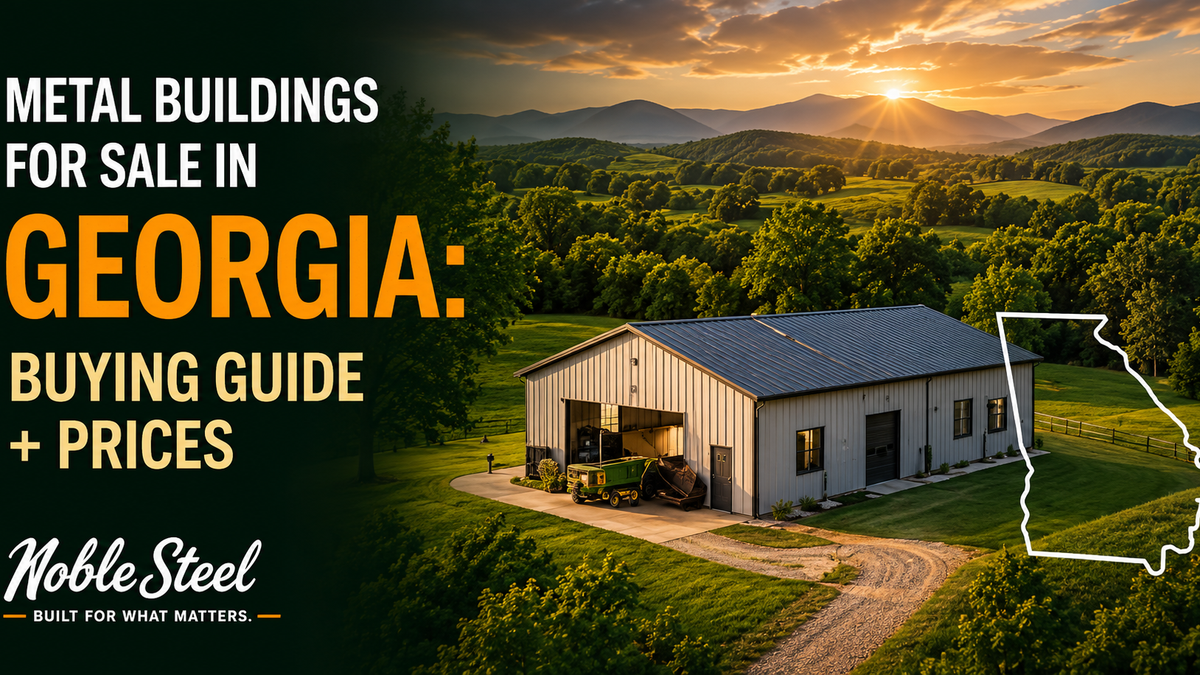
Georgia is one of the strongest metal building markets in the country. The combination of rural landowners, small agricultural operations, growing suburbs, and a business climate that still rewards getting things built has driven metal building demand across the state for years. But buying a building in Georgia comes with specific considerations — local codes, climate factors, and permitting realities that vary dramatically from county to county. Here's what you need to know.
Why Georgia Is a Top Metal Building Market
Georgia's geographic and economic mix creates near-perfect conditions for metal building demand:
- Agriculture: from the peanut farms of Southwest Georgia to the poultry and cattle operations in the North, agricultural storage is a constant need
- Rural land ownership: Georgia has millions of acres of privately held rural land where owners want functional, durable storage without the cost of conventional construction
- Small business growth: across the metro Atlanta exurbs, Savannah's industrial corridor, and secondary markets like Macon, Augusta, and Columbus, small businesses need cost-effective commercial space
- DIY and hobby culture: garages, workshops, and hobby buildings are a significant segment of the market
The state's mild winters and mostly favorable terrain also make building construction more straightforward than in harder climates — though Georgia has its own set of weather realities that matter when you're specifying a building.
What Metal Buildings Cost in Georgia in 2026
Georgia buyers are seeing the same national pricing trends as everyone else — steel costs are up from their pre-2021 baseline, and labor markets are tight. Here's what to expect for kit prices (delivered, not installed):
Add concrete, site prep, installation, and permits to get your real all-in number. For most Georgia buyers, a complete installed building runs 50–70% more than the kit price depending on site conditions and configuration.
The most popular size Noble Steel sells in Georgia mirrors the national trend: the 30x40 for residential and light commercial use, and the 40x60 for serious agricultural and commercial applications.
Georgia Weather and Building Specifications
This is one of the most important and most overlooked parts of buying a metal building in Georgia. The state has more weather variation than most people realize, and your building needs to be spec'd for where it's going — not just what looks good on paper.
Wind Load Requirements
Georgia is not a uniform wind zone. The coastal counties — Chatham, Bryan, Liberty, McIntosh, Glynn, Camden — are in high-wind areas due to hurricane exposure. Buildings in these counties require higher wind-load engineering than a building going up in, say, Tifton or Dalton.
The Georgia Wind Zone map designates most of the state as Wind Zone I or II, with coastal and near-coastal areas bumping to Zone II or III. Your building needs to be spec'd for the correct wind zone, which affects the gauge of framing, the fastener patterns, and in some cases the roof pitch.
If a company doesn't ask what county your building is going in, that's a problem.
Snow Load
Most of Georgia has minimal snow load requirements — the standard 20 psf (pounds per square foot) ground snow load covers the majority of the state. The exception is the North Georgia mountains (Blue Ridge, Ellijay, Dahlonega, and surrounding areas), where elevation brings real winter weather and snow load considerations.
If you're building in the mountains, ask specifically about snow load ratings. A building spec'd for coastal Georgia is not the right building for a mountain county.
Humidity and Condensation
Georgia summers are humid. Legitimately, seriously humid. A bare steel building without insulation will sweat — condensation forms on the interior of the roof and walls and drips onto whatever you've got stored inside. If you're using your building for anything beyond open livestock or equipment storage, insulation is not optional in Georgia. It's the difference between a functional building and one that rusts from the inside.
A vapor-barrier insulation package is the minimum for any Georgia building you plan to use regularly. For conditioned spaces or climate-sensitive storage, you'll want higher R-values.
Georgia Building Permits: What You Need to Know
Here's the honest answer about Georgia permits:it depends entirely on the county.
Georgia gives significant authority to individual counties and municipalities for building code enforcement. Some counties require full building permits, inspections, and engineer-stamped drawings for any structure with a foundation. Others — particularly in rural areas — have minimal oversight for agricultural buildings. A few have almost no enforcement for structures below a certain size.
What you should always do before ordering:
1. Call your county's planning and zoning office (not the tax assessor — zoning)
2. Ask specifically: "I'm planning to build a [size] metal building on my property. Do I need a permit? What are the setback requirements?"
3. Ask if engineer-stamped drawings are required for the permit
4. Ask about any HOA or covenants if your property is in a subdivision or planned community
Do not assume you don't need a permit because a neighbor built without one. Code enforcement varies, and the cost of being asked to remove an unpermitted structure is far greater than the permit itself.
Common permit requirements in Georgia counties:
- Foundation plan and anchor bolt layout
- Engineer-stamped drawings (for commercial or larger residential builds)
- Site plan showing setbacks from property lines
- Sometimes a survey if setbacks are close
Permit fees in Georgia typically run $200–$1,500 depending on the county and the assessed value of the structure.
Popular Metal Building Sizes in Georgia
Based on what Noble Steel sells in the state, here's where Georgia buyers tend to land:
30x40— the most common residential purchase. It's the right size for a 2–3 car garage, a hobby shop, or rural storage. It fits most Georgia residential lots comfortably and clears permitting without commercial-level complexity.
40x60— popular with small agricultural operations, contractors, and light commercial buyers. Enough space for equipment, inventory, or a combination shop-and-office setup.
30x50 and 40x80— common in agricultural areas, especially Southwest Georgia where row crop and poultry operations need reliable, cost-effective equipment and supply storage.
Custom widths and lean-tos— Georgia buyers frequently add lean-to additions to standard widths to get covered outdoor space for livestock, equipment parking, or workflow areas.
Why Georgia Buyers Should Work With Noble Steel, Not a Direct Manufacturer
Some buyers try to go direct to a manufacturer to cut out the middleman. Here's the reality: most manufacturers don't do small orders, don't navigate local code, don't have installer relationships, and won't walk you through the permit process. They'll ship you a kit and wish you luck.
A good metal building company that works the Georgia market knows:
- Which county offices to call and what they typically require
- Which install crews are reliable in different parts of the state
- How to spec a building for coastal wind zones vs. mountain snow loads vs. Piedmont standard builds
- Where to push back on upsells you don't need
Noble Steel works with Georgia buyers regularly. We know the market, we know the quirks, and we'll tell you straight what you need — and what you don't.
What to Expect When You Contact a Metal Building Company
A reputable company will ask you the following before quoting anything:
- What county are you building in?
- What's the building for? (use drives clearheight, door config, and insulation)
- What size are you thinking, and is that based on a specific need or a rough estimate?
- Do you have a level site, or will you need site prep?
- Do you have a concrete contractor, or do you need help with that?
- Have you checked with your county on permit requirements?
If a company skips these questions and just sends you a price sheet, you're getting a generic quote — not a building designed for your situation.
Noble Steel in Georgia
Noble Steel works with buyers across Georgia — from the suburbs of Atlanta to the farmland of South Georgia and the coastal developments near Savannah and Brunswick. We're not a franchise, we're not a big-box operation, and we're not going to push you toward the most expensive option.
We'd rather earn a customer for life than close a quick sale. That means telling you when a 30x40 is enough and you don't need the 40x60. It means flagging when your county will require engineer stamps so you're not surprised. It means helping you think through the full project cost — not just the kit price — before you commit.
Most companies won't tell you the parts of the deal that make it harder. We will.
Ready to get a real quote? Talk to Noble Steel — we'll help you find the right building or talk you out of the wrong one.