
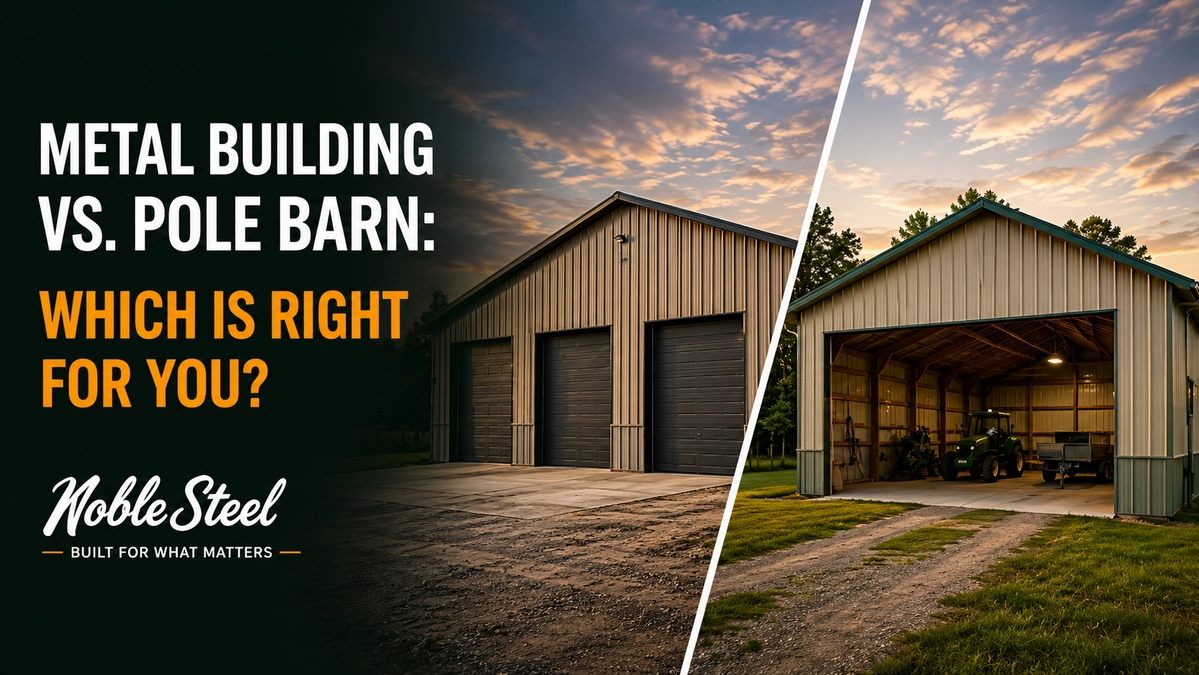
Most people searching "metal building vs. pole barn" already have a building in mind. They just want someone to confirm it. Here's the problem: the wrong confirmation costs you tens of thousands of do...
Metal Building vs. Pole Barn: Which Is Right for You in 2026?
Most people searching "metal building vs. pole barn" already have a building in mind. They just want someone to confirm it. Here's the problem: the wrong confirmation costs you tens of thousands of dollars over the life of that structure. So let's skip the cheerleading and actually compare these two options — construction method, cost, durability, and all.
Neither one is universally better. But one of them is almost certainly better *for your situation*. That's what we're here to figure out.
What's the Actual Difference? (Structure First)
Before you compare prices, you need to understand what you're comparing.
Pole barns(also called post-frame buildings) use large wooden posts buried in the ground or set on concrete piers as the primary structural support. The posts carry the roof load, which means you don't need a full concrete foundation. Walls are typically attached to horizontal girts that run between the posts. The frame itself is wood — engineered lumber or laminated posts.
Steel/metal buildingsuse a steel rigid-frame system — typically I-beam columns and rafters — anchored to a concrete foundation. The frame carries all structural loads. Wall and roof panels are steel. Nothing is buried in the ground; everything rests on a slab or perimeter foundation.
That difference in framing method drives almost every other comparison point.
Cost Comparison: Upfront vs. Lifetime
Upfront Cost
Pole barns have a genuine cost advantage at the point of purchase, and it's not trivial.
A basic 30x40 pole barn in 2026 might run you$15,000–$25,000for materials, depending on region and specs. A comparable steel building kit starts closer to$20,000–$35,000. Add foundation costs — pole barns require significantly less concrete — and the gap widens.
If upfront budget is your primary constraint, that's a real and legitimate reason to consider a pole barn.
Lifetime Cost
Here's where the math shifts.
Wood posts buried in the ground — even pressure-treated — are in a constant battle with moisture, insects, and rot. In humid states like Georgia, Tennessee, Mississippi, and the Carolinas, that battle has a known timeline. Most pole barn posts are rated for 20–30 years in-ground. Replacing them mid-life is expensive and disruptive.
Steel doesn't rot. Steel doesn't get termites. A properly maintained steel building in a non-coastal environment can last 50+ years with minimal structural intervention. The Galvalume and painted steel panels used on modern metal buildings are engineered to resist corrosion for decades.
Maintenance costs over a 25-year period also diverge. Wood-frame structures typically require repainting every 5–7 years, periodic post inspection and treatment, and occasional repair of warped or damaged members. Steel panels — once installed correctly — need little beyond occasional washing.
The short version:Pole barn wins on day one. Metal building wins on decade three.
Durability: Weather, Wind, and Load Ratings
Both building types can be engineered to meet local code — but they get there differently.
Steel buildings are engineered to specific wind and snow load ratings as part of the design. When you buy from a reputable company, your building is stamped by an engineer for your county's requirements. The rigid-frame system distributes loads predictably.
Pole barns can also be engineered — but the variability in construction quality is wider. A professionally designed post-frame building from an experienced builder is durable. A budget pole barn slapped together without engineering review is not. In high-wind corridors across the South and Midwest, that distinction matters a great deal.
For states like Texas, where wind events are severe and increasingly common, or Tennessee and Georgia, where wet winters create significant ground-moisture conditions, the engineering consistency of a steel frame is worth considering.
One honest caveat:a steel building is only as good as its foundation and installation. A steel frame on a poorly poured slab in shifting soil is not inherently better than a well-built pole barn. Installation quality matters for both.
Insulation: Which Is Easier to Condition?
If you plan to heat or cool the space — a shop, a garage apartment, a barndominium — insulation is a big deal.
Pole barnspresent some challenges here. The open-bay construction with exposed girts can make it harder to achieve a tight thermal envelope. Spray foam is commonly used to fill cavities and air seal, which works well but adds cost. The wood frame itself can also be a thermal bridge.
Steel buildingsalso have a thermal bridge challenge — bare steel is a conductor — but the building envelope is more predictable. Common solutions include:
- Fiberglass batt insulationwith a vapor barrier (builder's insulation packages)
- Spray foam on the interiorof steel panels
- Rigid foam board systems
- Insulated metal panels(IMP) — factory-insulated panels that dramatically simplify the process
For a barndominium or any living space, a metal building with a proper insulation package is generally easier to spec and execute than insulating a pole barn to the same standard.
Customization and Appearance
This one surprises people. Pole barns are not automatically more customizable than steel buildings.
Pole barnsoffer flexibility in interior layout because the posts are the structure — you're not working around interior columns. That's a real advantage for open floor plans. Exterior finishes vary widely: board-and-batten wood siding, metal panels, or composite materials are all common. They can look very traditional or very modern.
Steel buildingsalso offer significant customization — panel colors, wainscoting, trim packages, window and door configurations. The rigid-frame system does require the frame to be designed for your intended use, so layout changes mid-process are harder. But within a designed configuration, the customization options are extensive.
If you want a building that looks indistinguishable from a traditional barn, a pole barn is probably easier to achieve that aesthetic. If you want a sharp, durable structure with clean lines, metal buildings deliver that well.
Permitting Differences
This varies by county and state, but it's worth flagging.
Pole barnswithout full foundations sometimes fly under the radar in rural counties with limited enforcement — but that's increasingly rare and increasingly risky. As counties tighten building codes, structures built without permits can create problems at resale and with insurance.
Steel buildingstypically require permits in most jurisdictions, and the engineer-stamped drawings that come with a quality metal building package actually make that process easier. You show up to the county with a stamped set of drawings rather than trying to explain what you built.
In states like Georgia and Tennessee, where we work frequently, permitting requirements are increasingly uniform regardless of building type. Don't assume a pole barn is automatically a permit-free project.
Best Use Cases: Who Wins Where
Pole barn makes more sense when:
- Budget is the primary driver and the structure is low-occupancy (hay storage, equipment storage)
- You're in a region with stable, dry soil and low humidity
- You want a traditional aesthetic that blends with agricultural surroundings
- You plan to do the work yourself or with local labor who knows post-frame construction
- You don't need to condition the space
Metal building makes more sense when:
- You need a structure that will last 40+ years without structural intervention
- The space will be climate-controlled (shop, garage, barndominium)
- You're in a high-humidity state where ground moisture accelerates wood decay
- You want a clear-span interior with no interior posts
Noble Steel's Honest Take
We sell metal buildings. We don't sell pole barns. So you should weight our opinion accordingly — but here's what we actually tell people.
If you're storing hay and you need something up fast on a tight budget, a pole barn might genuinely be the right call. We'd rather tell you that than sell you a $45,000 steel building when a $20,000 pole barn solves your problem.
What we do push back on is the assumption that pole barns are always cheaper. When you price out the foundation savings against the lifetime maintenance costs — especially in the Southeast and Midwest where moisture is aggressive — the math is closer than it looks. And when you factor in insulation, permitting, and longevity, steel buildings win the total cost of ownership comparison in most scenarios.
We also push back on the idea that pole barns are "simpler." In the right hands, they are. But finding an experienced post-frame builder who will stand behind their work is its own challenge. With a steel building from a reputable company, the engineer-stamped drawings, manufacturer warranty, and installation accountability are part of the package.
Neither building type is a bad choice made honestly. The mistake is choosing based on gut feel, a YouTube video, or the first quote you got — without working through what you actually need.
Ready to Figure Out Which One Is Right for You?
We'll walk through your use case, your site, and your budget — and give you a straight answer, even if that answer is "honestly, you might want a pole barn for this one."
That's not how most building companies operate. It's how we do.
Ready to get a real quote? Talk to Noble Steel — we'll help you find the right building or talk you out of the wrong one. Get a Free Quote →