
There's a line in almost every metal building quote that catches buyers off guard: foundation not included. It's not hidden — it's standard across the industry — but if nobody explains it upfront, you...
Metal Building Foundation Requirements: What Goes Under Your Building
There's a line in almost every metal building quote that catches buyers off guard: foundation not included. It's not hidden — it's standard across the industry — but if nobody explains it upfront, you end up with a sticker shock moment when you realize the building price is only part of what you're spending. The foundation can add thousands of dollars to your project, and the type of foundation you need depends on your soil, your use case, and whether the building is permanent. Let's work through all of it.
Why Foundation Isn't Included in Most Metal Building Quotes
Metal building manufacturers build the structure. They're not in the concrete business. The building is manufactured to anchor to a foundation — the anchor bolt pattern is part of the engineering — but the foundation itself is site work, and site work depends entirely on local soil conditions, frost depth, drainage, local code requirements, and the specifics of your parcel.
No manufacturer can quote you on something they don't control. So the building price covers the steel — and with Noble Steel, that includes delivery and professional installation. Foundation and site prep are the pieces you'll coordinate locally. Not sure how to approach the site prep side? Noble Steel can help guide you through what your specific building will require and connect you with the right local contractors.
This isn't a bait-and-switch. It's just the reality of how the industry works. The important thing is to understand it before you budget your project.
The 3 Main Foundation Types
1. Concrete Slab (Most Common)
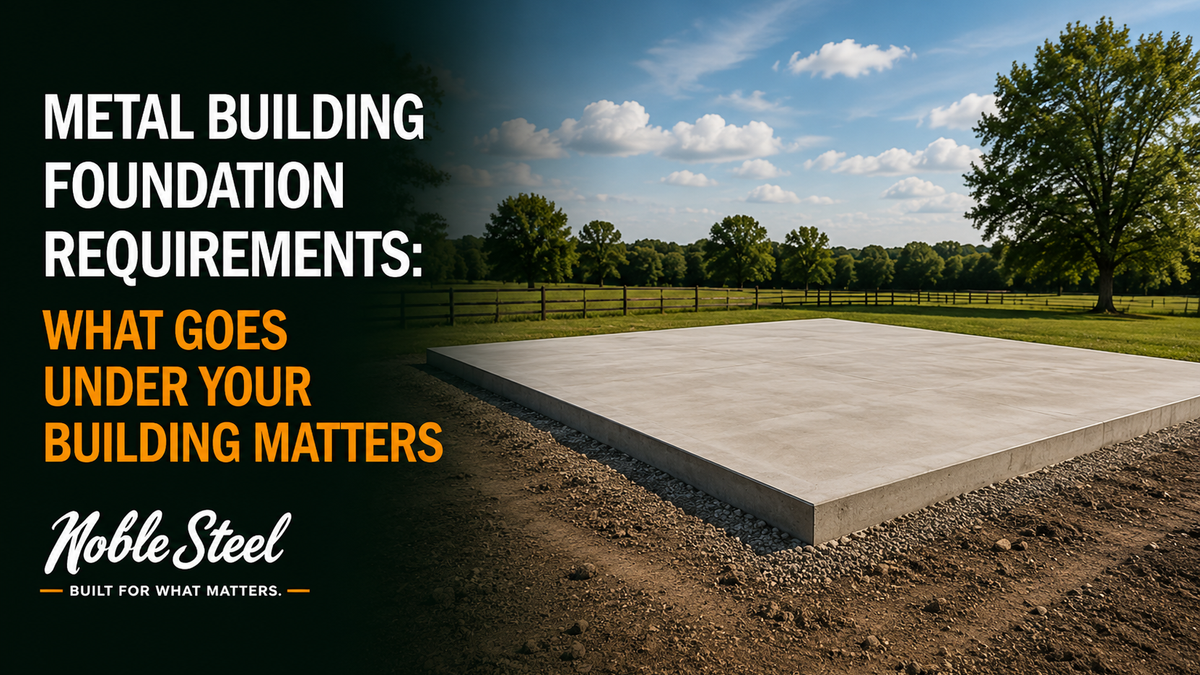
For permanent or semi-permanent residential and commercial metal buildings, a poured concrete slab is the standard. It's what most garages, shops, and agricultural buildings sit on. A properly done slab gives you a level, durable surface that anchors the building securely and provides a usable floor.
The typical spec for a residential metal building is a 4-inch slab with rebar or wire mesh reinforcement. For larger buildings or heavier use — vehicles, equipment, heavy machinery — a 6-inch slab with rebar on 18-inch centers is more appropriate. Your local contractor will assess your soil and recommend the right spec; this isn't a decision to make from a blog post.
The slab is poured with anchor bolt sleeves at the perimeter that match the building's anchor bolt pattern. This is why you need to have your building specs before you pour — the anchor pattern is building-specific.
2. Concrete Piers
For some building configurations — particularly open-sided shelters, carports, and ag structures — concrete piers are used instead of a full slab. Piers are poured at each column location, and the building anchors to the piers. The area between piers can be gravel, dirt, or poured later as a slab if needs change.
This approach costs less upfront than a full slab and works well for applications where a full floor isn't required — hay storage, equipment covered storage, lean-to additions. It's less suited for enclosed shops where you'll be walking around, doing detailed work, or keeping the space climate-controlled.
3. Treated Wood or Skids (Non-Permanent)
Some smaller buildings — particularly storage sheds and portable structures — can sit on pressure-treated skids or timber runners instead of concrete. This is generally only appropriate for smaller footprints, non-enclosed or lightly-enclosed structures, and situations where permanence isn't the goal or where local code doesn't require a concrete foundation.
Skid foundations are not suitable for vehicles in most cases (the weight and repeated loading requires concrete), and they're not appropriate for larger enclosed buildings. They do have the advantage of being movable — technically the building isn't permanently installed, which can affect how it's treated under zoning rules in some counties.
Typical Concrete Slab Costs by Size
Foundation costs vary significantly by region, soil conditions, local labor markets, and what your specific site requires. These ranges are real-world estimates for straightforward residential slab work — your actual quote may be higher or lower.
The wide ranges reflect real variation — gravel base requirements, drainage needs, local material costs, and labor rates all play a role. Sites with poor soil may require more preparation, deeper footings, or additional drainage work. Sites with excellent soil and easy access can come in at the lower end.
A per-square-foot estimate of $3–$8 is a reasonable planning range for most residential slab work in the Southeast and Midwest. Urban markets and coastal areas tend to run higher.
Get at least two local concrete contractor quotes. This is not a place to cut corners or hire based on price alone — a poorly poured slab is the kind of problem that never fully goes away.
Soil and Site Considerations
Not all soil is created equal. Clay-heavy soil expands and contracts with moisture changes, which can stress a foundation over time. Sandy soil drains well but may require a compacted gravel base before the slab is poured. Rocky soil can make excavation expensive. Low-lying areas may need drainage work or grading before you can pour.
Your concrete contractor should assess the site before quoting. Red flags include:
- Soft or spongy ground that doesn't compact well
- Poor natural drainage or areas that hold water after rain
- Significant slope that requires grading or a retaining wall
- Proximity to trees with aggressive root systems
If you're in an area with a frost line (significant portions of Illinois, Michigan, Indiana, Ohio, Kentucky, and Virginia), your footings may need to go below the frost depth to prevent heave. A local contractor will know the local frost depth requirements.
Getting the Anchor Pattern Right
Here's a practical detail that trips up first-time buyers: you need your building's anchor bolt layout before your slab is poured, not after. The anchor bolts are embedded in the concrete — if they're in the wrong spot, you have a real problem.
When you order your building, the manufacturer provides an anchor bolt plan showing exactly where the bolts need to be set. Share this with your concrete contractor before they pour. This is standard practice, but it requires coordination. Don't schedule your slab pour until you have the anchor plan in hand.
Use a Local Contractor for Your Foundation
This is worth being direct about. We know customers sometimes want to find every possible way to reduce cost, and DIY concrete is something some people attempt. For a small slab, it's possible. For anything larger than a small storage building, it's not a project for a first-timer.
Getting the grade right, placing rebar correctly, setting anchor bolts to spec, and finishing the surface properly requires experience and equipment. A bad slab can affect the building's structural integrity, cause drainage problems inside the building, and create headaches that are genuinely difficult to fix after the fact.
Hire a local concrete contractor who has done metal building slabs before. Ask them specifically about anchor bolt placement. It's not a complicated conversation, but it's one worth having explicitly.
What Noble Steel Covers and What We Don't
We provide the building. We provide the engineering specs, including the anchor bolt layout. We'll make sure you have everything your contractor needs to pour a correct foundation.
What we don't do is coordinate or subcontract your foundation work. That relationship is between you and your local concrete contractor. We're happy to tell you what questions to ask and what to watch out for — but the foundation is local work, and it needs to stay local.
Ready to get a real quote? Talk to Noble Steel — we'll help you find the right building or talk you out of the wrong one.