
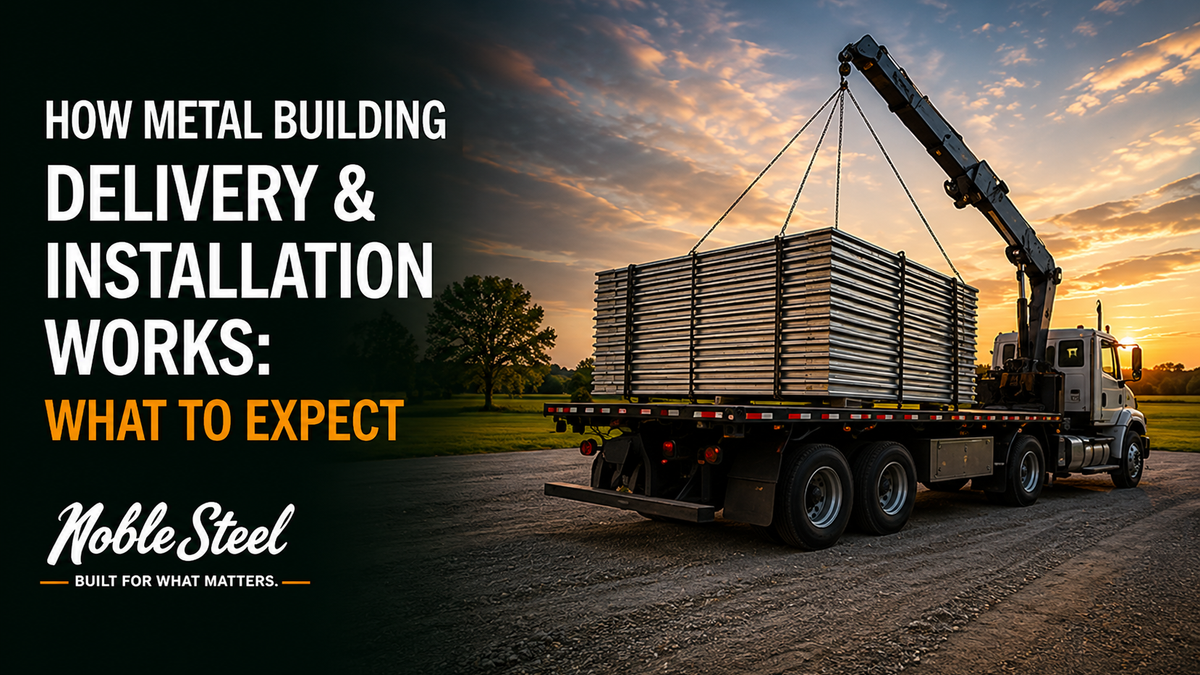
A lot of first-time buyers picture the building arriving fully assembled on a flatbed, getting lifted into place, and being done by the end of the day. That's not what happens. Understanding what the ...
How Metal Building Delivery and Installation Works: What to Expect
A lot of first-time buyers picture the building arriving fully assembled on a flatbed, getting lifted into place, and being done by the end of the day. That's not what happens. Understanding what the delivery and installation process actually looks like — before you order — helps you plan your site, coordinate your contractors, and avoid surprises when the truck shows up. Here's the real picture.
The Timeline: Order to Delivery
Plan for 4 to 12 weeks from the time you place your order to the time your building arrives on your property.
The wide range is real, and it's driven by a few factors:
Manufacturer backlog:During peak building season — spring and early summer especially — lead times stretch. Manufacturers running at capacity can push lead times to 10–12 weeks. Off-peak ordering (fall and winter) often brings lead times down to 4–6 weeks.
Building complexity:Standard sizes with standard options move through production faster than custom widths, non-standard heights, or buildings with a lot of add-ons. If you're building something straightforward, you have more scheduling flexibility.
Permitting:If your county requires a permit before work can begin, that process runs parallel to your order timeline — sometimes ahead of it. A permit approval that takes 6 weeks doesn't push back your delivery date if you submitted the application early, but if you wait until after you order to start the permit process, you may find yourself waiting on the permit after the building has already arrived.
The practical advice: ask for a lead time estimate when you get your quote, and work backward from your target completion date. If you need the building done by a specific date — before winter, before a business opens, before a lease expires — start that conversation early.
What "Delivery" Actually Means
This is the most important distinction in this entire post: delivery and installation are not the same thing.
Kit deliverymeans the manufacturer ships your building as a disassembled kit. A truck arrives with the steel panels, framing components, hardware, and instructions. It gets offloaded at your property — or as close as the truck can get — and that's where the manufacturer's responsibility ends. What happens next is up to you.
Turnkey installationmeans a crew arrives, assembles the building on your prepared foundation, and completes the installation. You end up with a finished structure.
Not every company offers both options. Not every manufacturer ships directly to the job site. The terms vary depending on the company, the manufacturer, and your location. You need to know which type of delivery you're getting before you sign anything.
At Noble Steel, delivery and installation are included — period. When you buy through us, a professional crew delivers your building and puts it up. You're not managing freight logistics or sourcing your own erection crew. That's the Noble difference, and it's something most companies can't say. We work with Reliable Buildings on the installation side, so you get a crew that knows our product and does this every day.
Buying a Kit vs. Hiring an Installation Crew
If you're receiving a kit and assembling it yourself (or hiring your own crew), here's what that actually involves: unloading and organizing the components, following the manufacturer's assembly instructions, erecting the frame, attaching wall and roof panels, installing doors and windows, and anchoring the structure to your foundation.
For a simple, smaller building, an experienced DIYer with a few helpers and the right equipment can manage this. For anything larger — say, a 30x40 or bigger — you're talking about panels that are physically heavy and awkward, framing components that require multiple people and often a lift or crane, and a process where mistakes are hard to undo. Most buyers at this scale are better served by hiring experienced installers.
If you're going with a professional installation crew, the scope should be clearly defined in writing: what they're installing, what they're not, how the site needs to be prepped before they arrive, and what happens if they encounter site issues.
Site Prep Before Delivery Day
Your site needs to be ready before anything arrives — and this is one area where Noble Steel can help you think it through. Not sure what your specific building requires? Ask us before you start. We'll walk you through what the installation crew needs to see when they arrive, and we can point you toward local contractors who've worked with our buildings before.
Level pad:Your foundation — concrete slab, piers, or gravel pad depending on the building type — needs to be complete and level before delivery. The building is designed to sit on a level surface; trying to compensate for an unlevel foundation during installation creates problems throughout the structure.
Truck access:The delivery truck is a large commercial vehicle. It needs a route to your property that clears low-hanging branches, doesn't have weight-restricted bridges, and has enough turning radius to maneuver. Think about this in advance, especially on rural properties with narrow lanes or soft shoulders. If the truck can't reach the site, the materials get offloaded wherever it can stop — and moving steel panels across a field by hand is not a pleasant situation.
Clear work zone:The area around where the building will be erected needs to be clear of obstacles. The installation crew (or you and your helpers) need room to lay out components, move around the structure, and work safely. Don't wait until installation day to realize there's a fence or equipment in the way.
Utilities:If you're planning electrical service to the building, talk to your electrician before the building goes up. It's significantly easier to plan conduit runs and panel placement before the walls are on than after.
What Happens on Installation Day
For a turnkey installation, here's the general sequence of events:
The crew arrives and does a site assessment — confirming the foundation is level, checking anchor bolt placement, and planning the build sequence. Framing goes up first: the main columns and rafters. Then purlins and girts (the secondary framing members that support the panels). Then wall panels, starting typically at one end and working across. Roof panels go on, and then doors, windows, trim, and hardware are installed.
For a 30x40 building, a competent crew typically completes installation in 1–3 days depending on the building's complexity and site conditions. Larger buildings take proportionally longer. Weather is a factor — installation doesn't happen in high wind, and wet conditions affect both safety and the quality of work.
The installation crew will need access to electricity on-site (for power tools) and should confirm this with you before the install date.
Common Installation Questions
Can I be there on installation day?Yes, and it's worth being present at least for the start of the day. Walk through the site with the crew lead, confirm the anchor bolt layout looks right before they start building on it, and make sure any questions about door placement or optional features are addressed before those decisions are locked in.
What if there's a problem with the components?Damaged or missing parts do occasionally happen. A good company has a process for this — document it immediately, photograph everything, and contact us. We'll work to get replacement components on the way.
Who's responsible if something goes wrong during installation?This depends on whether you're doing a DIY kit assembly or using a professional crew. If you hired an installation crew, their liability for workmanship issues should be part of your agreement with them. If you're assembling yourself, the manufacturer's warranty covers the components, not the assembly.
Noble Steel's Process With Reliable Buildings
We work with Reliable Buildings on the installation side of the business. When you order through Noble Steel, we coordinate the manufacturing and logistics, and we're your point of contact throughout the process. If you have questions between the time you order and the time your building arrives, you're calling us — not hunting down a manufacturer's customer service line.
We'll tell you your lead time up front, what your delivery looks like, and what you need to have ready before the truck arrives. No surprises is the goal.
Ready to get a real quote? Talk to Noble Steel — we'll help you find the right building or talk you out of the wrong one.