
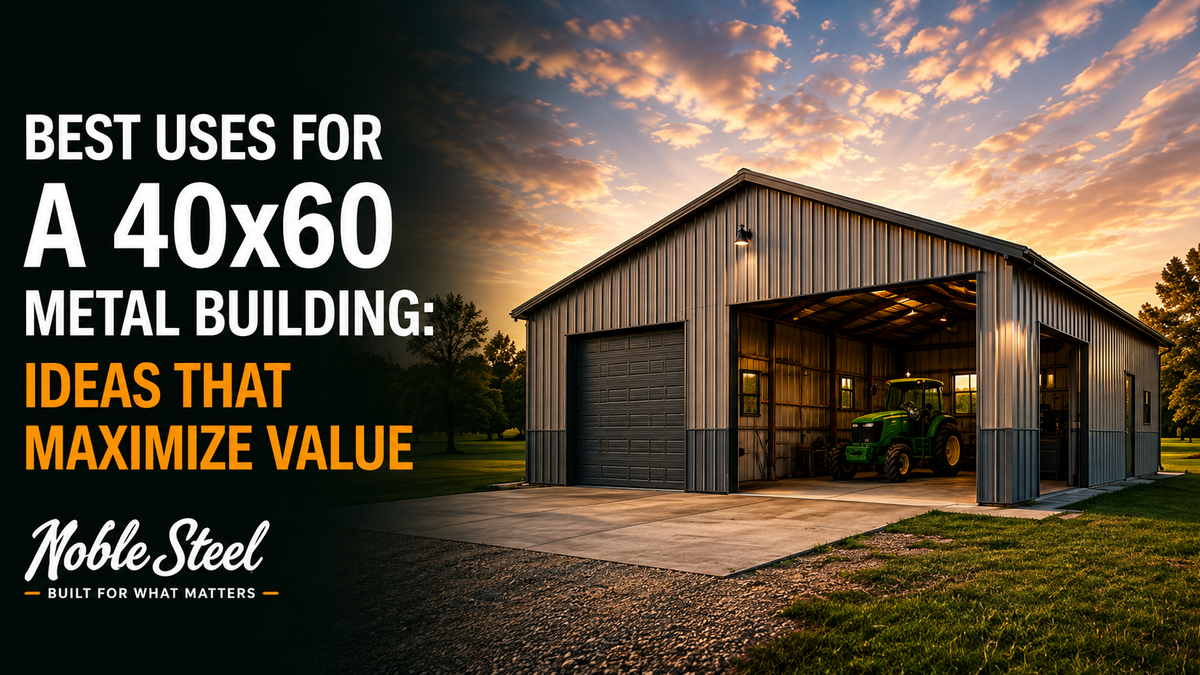
The 40x60 is one of the most popular metal building sizes in the country. At 2,400 square feet of footprint, it sits in a range that works for a wide range of purposes — big enough to be genuinely use...
Best Uses for a 40x60 Metal Building: Ideas That Maximize Value
The 40x60 is one of the most popular metal building sizes in the country. At 2,400 square feet of footprint, it sits in a range that works for a wide range of purposes — big enough to be genuinely useful, small enough to be achievable on most rural and semi-rural lots.
The question isn't whether a 40x60 works. It's what you're going to do with it.
Here are the uses that consistently deliver the most value from a 40x60 steel building.
1. Home Workshop or Hobby Shop
This is the most common use for a 40x60 among residential buyers, and with good reason. A 40x60 gives you 2,400 square feet of covered, secured workspace — enough room for a full woodworking setup, a car restoration bay, a fabrication shop, or a serious hobby space with room left over for storage.
What makes it work:
- Clearspan construction means no interior posts interrupting the floor plan
- 12–14 foot eave heights accommodate most vehicle lifts and overhead equipment
- Concrete slab floor holds up to heavy equipment, welding, and daily shop use
- Overhead doors sized to your actual equipment — not a compromise
One or two 10x10 or 12x12 overhead doors on the end wall, a walk door on the side, basic electrical, and LED shop lighting covers 90% of residential shop setups.
2. Farm or Agricultural Storage
Farms run on covered storage. A 40x60 handles most of what a mid-size operation needs: a tractor, an implement or two, seed, feed, hay bales, and the tools that go with it.
What makes it work:
- Ag buildings often have 14–16 foot eave heights to clear larger equipment
- End wall doors can go up to 14x14 or 16x16 for combine headers and wide equipment
- Gravel floor is common and acceptable for pure storage; concrete adds cost but increases utility
- Lean-tos off one or both sides can add covered area for additional equipment or materials
If you're farming and you're still working without covered equipment storage, the annual losses to weather — rust, UV damage, wear on rubber and seals — add up faster than the building cost.
3. Multi-Vehicle Garage
A 40x60 comfortably holds four to six vehicles depending on how you configure it. Most residential multi-vehicle garages are 2–3 cars at best. A 40x60 is in a different category — a real collector's garage, a restoration shop with parking, or a family property where everyone's vehicles have a covered home.
Common configurations:
- Four standard vehicles with room for workbenches along the walls
- Two full-size trucks with a boat and a UTV
- Three vehicles plus a dedicated detailing bay and parts storage
- A combination of vehicle storage and enclosed mechanical workspace
Tall doors matter here. If you're storing trucks, motorhomes, or trailers, plan for 12x14 or 14x14 overhead doors — not the 9x8 you'd find on a standard residential garage.
4. Small Commercial or Business Operation
A 40x60 sits at the bottom of the commercial range but covers a lot of small business needs. Contractors, landscapers, small manufacturers, HVAC shops, plumbers, and electricians all operate out of 40x60 steel buildings regularly.
What makes it work commercially:
- Separate office space can be built into one end — 200–400 sq ft enclosed and finished
- The open floor handles equipment, inventory, and a work area simultaneously
- Overhead door placement on the side wall (rather than end wall) can improve workflow for service businesses that pull vehicles in and out frequently
- The structure cost is a fraction of a wood-frame commercial build for the same square footage
If your business is currently renting storage or shop space, the math often works strongly in favor of owning. The rent you're paying to someone else is building equity in nothing.
5. Barndominium or Full Residential Conversion
A 40x60 is the most common footprint for a barndominium primary residence. At 2,400 square feet under one roof, you have enough room to build a real home — 2 to 4 bedrooms, 2 bathrooms, a full kitchen, open living space — and still have a separate garage bay on one end.
Why a 40x60 works for residential:
- The 40-foot width accommodates standard residential room layouts without cramping
- Steel construction gives you the shell durability that wood framing can't match — fire resistance, wind resistance, pest resistance, lower insurance in many states
- The open-plan architecture of a clearspan building is a natural fit for the open-concept layouts that define modern barndominium design
- Per-square-foot construction cost is typically lower than a comparable wood-frame home in the same market
The finishing costs on the interior are similar to any custom home — plumbing, electrical, HVAC, drywall, flooring, fixtures. What you're saving is on the shell itself.
6. Event Barn or Entertainment Space
A 40x60 with the right configuration is a legitimate event venue. Wedding barns, private party spaces, family gathering halls, and agritourism properties run on buildings in this size range.
What makes it work:
- Large overhead doors or sliding barn doors on the end wall open the space and create a natural flow between indoor and outdoor
- 14–16 foot eave heights give the interior the volume that events need to feel right — not cramped, not a garage
- A small prep kitchen, restrooms, and a storage closet can be built into one end
- LED string lighting and exposed steel purlins create the aesthetic that event renters actually want
If you own rural property, an event barn in this size range can generate income. The demand for private, non-hotel wedding and event venues in rural areas is real and growing.
7. Equipment Storage Plus Living Quarters
The classic working man's setup: the majority of the building is equipment and shop, with one end finished out as living quarters. On a 40x60, that typically looks like 1,400–1,600 sq ft of shop and 800–1,000 sq ft of living space — a bedroom or two, a full bathroom, a kitchen, a living area, and a separate entrance.
Who builds this:
- Hunters and outdoor enthusiasts who want a comfortable base on rural property without a separate house
- Farmers or ranchers who need to stay on-site during critical seasons
- Contractors who live where they work — shop in the same building as home
- People building in phases — live in the quarters while the primary home gets built elsewhere on the property
The cost per square foot of finished living space inside a metal building is lower than a standalone home in most markets. The shop side is just... the shop. You're not paying to finish what doesn't need finishing.
8. Climate-Controlled Storage
Self-storage runs on metal buildings. A 40x60 with a few interior partition walls can become eight to twelve individual storage units, climate-controlled or not. On rural land with road access, a small-scale storage operation is a genuinely viable business in most markets.
More commonly, buyers use a 40x60 for personal climate-controlled storage — wine, collectibles, records, furniture, a vehicle collection that needs year-round temperature control. Spray foam insulation on the walls and roof deck plus a properly sized mini-split system gives you a building that holds temperature all year with minimal operating cost.
Getting the Right Structure for What You're Building
The single biggest mistake with a 40x60 is ordering the structure before the use case is fully resolved. The door package, eave height, roof pitch, interior post configuration, and rough openings for windows are all set at the factory. Change them after the building is ordered and you're paying to change engineered steel.
Nail down what the building is actually for first. Then spec the structure around that. The structure cost difference between a standard residential shop and a commercial-grade operation with high doors, a lean-to, and extra overhead openings can be $10,000–$20,000 — and it's worth paying if it's what you actually need.
Noble Steel quotes 40x60 structures for every use on this list. Tell us what you're building and we'll make sure the structure matches it.
Ready to price a 40x60 for your specific use?