
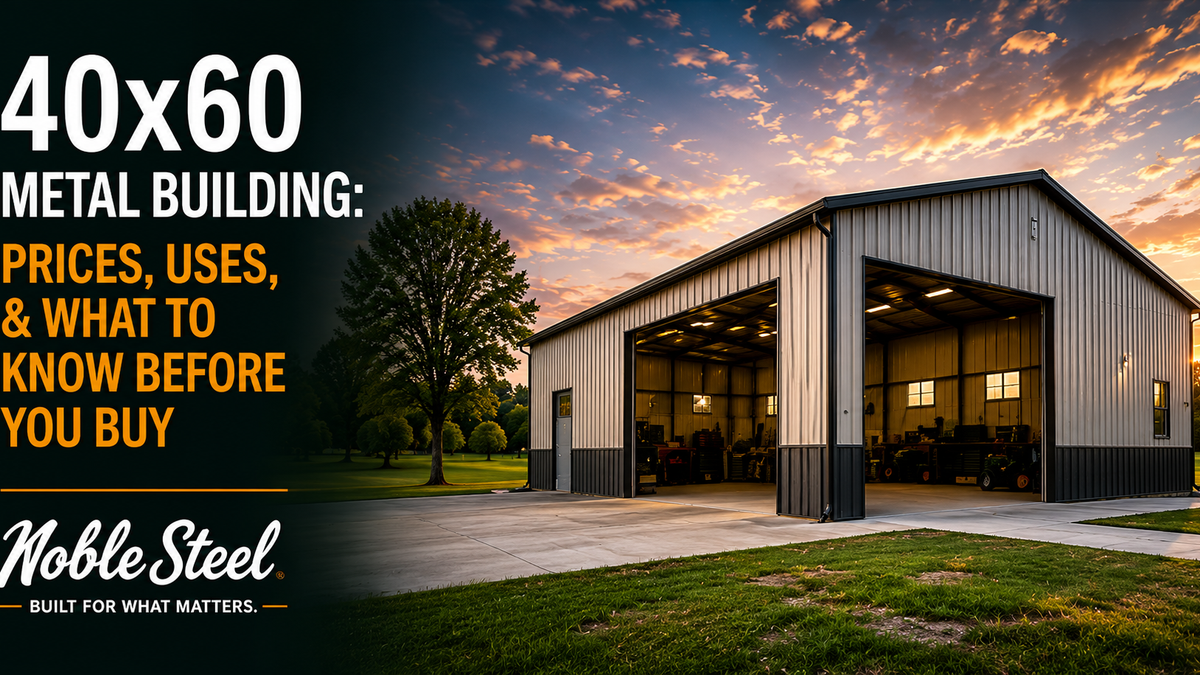
A 40x60 steel building kit — delivered, not installed — typically runs$43,000 to $55,000in 2026. That's the steel: the primary framing, secondary framing, roof panels, wall panels, trim, and a standar...
40x60 Metal Building: Prices, Uses, and What to Know Before You Buy
What Does a 40x60 Metal Building Cost in 2026?
A 40x60 steel building kit — delivered, not installed — typically runs$43,000 to $55,000in 2026. That's the steel: the primary framing, secondary framing, roof panels, wall panels, trim, and a standard door or two. It doesn't include your concrete slab, installation, site prep, or any permits.
Here's a realistic all-in budget if you're starting from scratch:
That's a real number. Anybody quoting you a fully installed 40x60 for $45,000 is leaving something out — or planning to add it back in later.
What moves the kit price up or down within that $43K–$55K range? A few key things:
- Gauge of steel: heavier (lower-number) gauge costs more, holds up longer
- Clearheight: standard is 12–14 ft; going taller adds cost
- Number and size of doors: every roll-up door or overhead door adds to the price
- Insulation package: often quoted separately
- Color selection: standard colors are typically included; specialty colors may cost extra
Why the 40x60 Is One of the Most Popular Sizes
2,400 square feet of clear-span space is a genuinely useful amount of room. No interior columns means you can park a combine, store multiple vehicles, run a workshop, or build out a commercial space without working around structural obstructions. That clear-span capability is one of the biggest advantages metal buildings have over traditional pole barns or wood-frame construction.
Here's what a 40x60 footprint can actually hold:
- 4–6 full-size vehicleswith room to move around
- Large agricultural equipment— tractors, trailers, implements
- A working shopwith equipment, benches, and storage
- A small commercial operation— retail, light manufacturing, service business
- Boat or RV storagewith appropriate door height
- Inventory or warehouse spacefor a small business
The question isn't whether a 40x60 is big enough for most of those uses. It usually is. The question is whether it's the right size for *your* use — which is something worth thinking through before you order.
Common Uses for a 40x60 Metal Building
Large Workshop or Garage
The most common residential use. At 2,400 square feet, you have room for a serious workshop setup — woodworking, welding, automotive — plus storage. Most buyers in this category go with a 12–14 ft clearheight, two 10x10 roll-up doors, and an insulation package so the space is workable year-round.
Equipment and Agricultural Storage
Farmers and ranchers love the 40x60 for equipment storage. You can get a large-format overhead door — 14x14 or even 16x16 — to accommodate full-size equipment. If you're protecting expensive machinery from weather and theft, this is a sound investment that typically pays for itself in reduced maintenance costs and longer equipment life.
Commercial and Light Industrial
Small businesses use 40x60 buildings for light manufacturing, service operations, auto repair shops, and inventory storage. In many counties, a metal building in this size range is significantly faster to permit and erect than conventional construction. That matters when you're trying to open a business.
Combination Shop and Office
A popular configuration is a 40x60 with a portion walled off for a conditioned office or showroom. The rest stays open for shop work or storage. You'll need an HVAC contractor and an electrician, but the shell gives you a solid starting point.
What's Included — and What's Not
This is where buyers get tripped up. When a company quotes you a 40x60, here's what's typically included in the kit price:
Included:
- Primary steel framing (columns, rafters)
- Secondary framing (girts, purlins)
- Roof and wall panels
- Trim package
- One or two standard walk doors
- Basic fasteners and anchors
- Delivery and installation (included with Noble Steel — not standard with most companies)
Not included:
- Concrete foundation or slab
- ~~Installation / labor~~ — already included with Noble Steel
- Roll-up or overhead doors (often extra)
- Insulation
- Windows (beyond basic, if any)
- Electrical, plumbing, HVAC
- Site preparation
- Building permits
- Engineer-stamped drawings (sometimes extra)
The gap between "kit price" and "installed and ready to use" is consistently larger than people expect. Budget it out fully before you compare quotes from different companies — otherwise you're comparing apples to oranges.
Clearheight: How Tall Does Your 40x60 Need to Be?
Standard clearheight options for a 40x60 run from 10 feet to 16 feet at the eave. Here's a quick guide:
- 10 ft: fine for standard vehicle storage, light storage
- 12 ft: the most common choice — fits most pickup trucks, trailers, and light equipment with room to spare
- 14 ft: right call if you're storing taller equipment, boats on trailers, or want overhead mezzanine space
- 16 ft+: necessary for full-size ag equipment, large commercial vehicles, or if you're planning a mezzanine
Clearheight affects both the cost and the permit classification in some jurisdictions. If you're on the fence, go one size up — the marginal cost is relatively small and you won't regret the headroom.
Gauge Options: What You Need to Know
Primary framing in a 40x60 typically comes in 12-gauge or 14-gauge steel. Secondary members (girts, purlins) are usually 14 or 16 gauge.
- 12-gauge primary framing: stronger, heavier, better for high-wind or high-load applications — and costs more
- 14-gauge primary framing: the standard for most commercial and residential applications — appropriate for most buyers
If your building is going up in a high-wind area or you're planning to load up a mezzanine, ask about what gauge is spec'd for your local conditions. Some states and counties have minimum requirements. If they don't ask about your location, that's a red flag.
What to Watch Out For When Shopping 40x60 Buildings
Low-ball kit prices.A $28,000 quote for a 40x60 kit sounds great until you find out it's 16-gauge framing, no insulation, no overhead doors, and freight is extra. Always get an itemized quote.
Vague delivery terms.Ask exactly where the freight cost breaks. "Free delivery" often means free within 50 miles. If you're further out, that's real money.
No engineer stamp.Most counties that require a building permit will also require engineer-stamped drawings. If they don't mention this, ask. Getting stamps retroactively is more expensive than getting them upfront.
Pressure to decide fast.Steel prices do fluctuate, and locking in a price makes sense if you're ready to move forward. But high-pressure tactics to sign today are a sign to slow down, not speed up. A good company will give you time to make a sound decision.
Cookie-cutter quotes.A 40x60 in coastal Florida has different engineering requirements than a 40x60 in Kansas. If a company doesn't ask about your location, snow loads, wind exposure, or local code, they're not spec'ing your building — they're quoting a generic one.
Is a 40x60 the Right Size for You?
Here's a quick gut-check:
- If you need space for 2–3 vehicles plus a workshop area, a 30x40 or 30x50 might serve you better at lower cost
- If you're running a commercial operation, storing full-size ag equipment, or need serious inventory space, the 40x60 is a natural fit
- If you're thinking "I might grow into the space" — that's a good instinct. It costs significantly less to build bigger upfront than to add on later
If you're not sure, tell us what you're trying to do. We'll help you figure out whether a 40x60 is the right call or whether something smaller (or larger) makes more sense for your situation.
One more thing worth knowing:Noble Steel offers seasonal promotions and limited-time pricing windows throughout the year. If you're in the market for a 40x60 and one of those windows is open, that's real money on the table. Ask us what's currently available — these discounts don't wait.
Ready to get a real quote? Talk to Noble Steel — we'll help you find the right building or talk you out of the wrong one.