
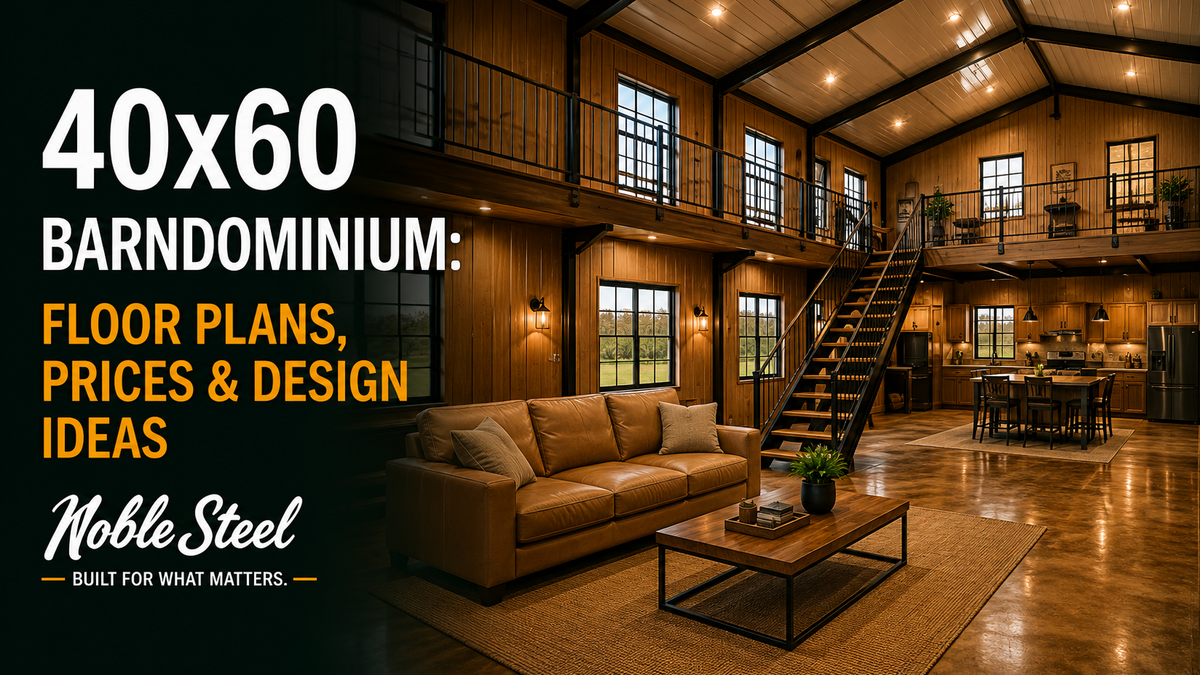
The 40x60 is the barndominium sweet spot. Not too small to feel like a compromise. Not so large that the build becomes a full-scale commercial project. At 2,400 square feet of footprint, a 40x60 gives...
40x60 Barndominium: Floor Plans, Costs, and What to Expect
The 40x60 is the barndominium sweet spot. Not too small to feel like a compromise. Not so large that the build becomes a full-scale commercial project. At 2,400 square feet of footprint, a 40x60 gives most families everything they actually need — livable square footage, room for a shop or garage, and a build cost that's ambitious but achievable.
Here's what you need to know before you go any further.
Why 40x60 Works for So Many People
The math works out nicely. A 40x60 structure gives you 2,400 square feet under roof to work with. Depending on your floor plan priorities, you can configure that into:
- A 3-bedroom, 2-bathroom home of 1,800 sq ft with a 600 sq ft two-car garage
- A 1,200 sq ft home with a 1,200 sq ft workshop — the classic shop-house
- A 2,000 sq ft open-concept living space with a utility/mudroom and covered lean-to on the back
- A 2-bedroom guest-friendly home with a large entertainment or hobby space
The 40-foot width is wide enough to accommodate standard room layouts without feeling cramped. The 60-foot depth gives you enough front-to-back dimension to separate living and working zones with meaningful space between them.
For context: most tract home builders would describe a home in this footprint range as a "comfortable family home." The difference is that you're building it in steel, on land you choose, with the floor plan you actually want.
Common 40x60 Barndominium Floor Plan Layouts
There is no single "standard" barndominium floor plan for a 40x60. That's part of the appeal. But there are four configurations that come up again and again for good reasons.
Layout 1: Shop-Dominant with Living Quarters on One End
Breakdown:~800–1,000 sq ft of living / 1,400–1,600 sq ft of shop or garage
This layout treats the building primarily as a working shop with high-quality living quarters attached. The living end typically has one or two bedrooms, a full bathroom, an open kitchen/living area, and a separate entrance from the shop.
Who it's for:Farmers, contractors, mechanics, hobbyists, or anyone who wants a comfortable place to sleep and eat without driving 20 minutes from the property.
Structural considerations:You'll typically want a large overhead door (12x14 or 14x14) on the shop end and a separate walk-in entrance on the living end. The transition between living and shop space is usually handled with a firewall or insulated partition wall.
Layout 2: 50/50 Home and Shop
Breakdown:~1,200 sq ft of living / ~1,200 sq ft of shop or garage
This is the most balanced configuration. The living side is a fully functional home — 2 to 3 bedrooms, 2 bathrooms, full kitchen. The shop side has room for 2–3 vehicles or a solid working shop. Both sides get finished to their appropriate level: drywall and flooring on the living side, sealed concrete and LED work lighting on the shop side.
Who it's for:Families who work from their property and need real home space plus functional shop space. Common with small business owners who run equipment, a small fleet, or a hobby that requires serious space.
Structural considerations:The partition between home and shop is important. If you want the shop door on the side of the building rather than the end, that decision needs to be made before the structure is ordered.
Layout 3: Full Residential Conversion
Breakdown:~2,200–2,400 sq ft of living space with minimal or no dedicated shop
This layout treats the 40x60 as a house first and foremost. The result is a genuinely spacious home — open-concept kitchen and living with high ceilings, 3–4 bedrooms, 2–3 bathrooms, a utility/mudroom, and a 2-car garage either integrated or in a separate lean-to.
Who it's for:People who chose barndominium construction for the durability, the open floor plan, and the build economics — not because they need a shop. Primary residence builds often go this direction.
Structural considerations:With more interior walls, door placement on the perimeter becomes critical. You'll want input from an architect or experienced barndominium designer before finalizing the structure order.
Layout 4: Loft-Style Open Concept
Breakdown:Main floor living with a partial loft above, typically 1,600–1,800 sq ft finished equivalent
A 40x60 with a steep enough roof pitch and adequate eave height (16 feet minimum, 20 feet preferred) can support a structural loft — effectively a second floor over a portion of the living space. This adds sleeping loft space, a home office area, or bonus room without changing the building footprint.
Who it's for:Couples or smaller households who want drama and character in the space — high ceilings, open volume, industrial aesthetic — and don't need as many enclosed bedrooms.
Structural considerations:This is where ridge height and eave height matter most. If you want a usable loft, you need to spec the building with that height from the start. You cannot add meaningful loft space after the fact.
What Does a 40x60 Metal Building Structure Cost?
The steel structure — the building kit itself — is what Noble Steel provides. For a 40x60 barndominium structure, here's what you're realistically looking at in 2026:
Structure-only cost range: $40,000–$55,000
That range reflects a standard 40x60 clearspan steel building with:
- Primary and secondary steel framing
- Standing seam or R-panel roof and wall panels
- Basic door and window openings as specified
- Engineering drawings stamped for your state's code requirements
What pushes cost toward the higher end:
- Extra overhead doors (each one is a significant structural opening)
- Lean-to additions off one or both sides
- Higher eave height (needed for the loft layout)
- Upgraded insulation package in the building kit
- Stricter local wind/snow load requirements
What pushes cost lower:
- Simpler door package
- Standard eave height (12 feet is common; it's serviceable for residential use)
- Standard R-panel roofing and siding
This is the number Noble Steel can give you precisely — we build the quote around your actual specs, not a rough estimate.
Total All-In Cost for a 40x60 Barndominium
The structure is one cost layer out of several. Here's a realistic all-in picture for a 40x60 barndominium:
Most completed 40x60 barndominiums land in the$150,000–$200,000 rangefor a comfortable, livable primary residence with mid-level finishes. Rural utility hookups and premium interior finishes push toward the top of the range or beyond.
What You Get with Different Finish Levels
The structure and foundation cost is relatively fixed. The interior finish is where you make the most consequential spending decisions.
Entry-level finish ($20–$35/sq ft of living space):
Drywall or shiplap walls, LVP flooring or stained concrete, standard cabinets from a home center, basic plumbing fixtures. Functional and clean, but you'll know you took the budget route. This is the starting point, not the destination, for most primary-residence builds.
Mid-level finish ($40–$70/sq ft of living space):
Upgraded flooring (LVP or hardwood), semi-custom cabinetry, stone or quartz countertops, a tile backsplash, upgraded lighting fixtures. This is where most people land when they're building a home they plan to live in for 10+ years. Comfortable, attractive, and not wildly expensive relative to what you're getting.
High-end finish ($75–$100+/sq ft of living space):
Custom millwork, tile showers, high-end appliances, integrated smart home systems, premium lighting throughout. At this level, you're spending as much as you would on any custom home — and you're getting a custom home result in a steel shell with better durability and a shop attached.
Decisions to Make Before You Order Steel
This part matters more than most people realize. The metal building structure is manufactured to your specifications. Once it's built and shipped, certain things cannot change without significant expense. Nail these down before you place an order:
Door placement.Overhead garage doors and large walk doors are structural openings. Where they go determines what your floor plan can do. If you want an overhead door on the side wall, that's a different engineering spec than an end-wall door. Decide this before the order goes in.
Eave height.Do you want 12-foot ceilings, 14-foot ceilings, or higher? Do you want a loft? Eave height is set at the factory. Standard residential barndominiums typically use 12–16 foot eave heights. Higher heights add cost but add visual drama and functional space.
Lean-to additions.Want a covered porch on the front? A carport off the back? A storage lean-to on the side? These are part of the structure order, not something you add after the fact (at least, not without a more expensive retrofit).
Interior post locations.If you're building clearspan (no interior posts in the living area), the engineering is designed around that. If you're okay with posts, the building costs less. Know which you want.
Window placement.Rough openings for windows are cut into the panels. Decide where your windows go as part of the floor plan process, not after.
Working with Noble Steel on a 40x60
Noble Steel's role is the metal building structure. We'll quote your 40x60 with the door package, eave height, roof pitch, and openings that match your floor plan. We'll tell you if something you're planning doesn't make structural sense — that's part of the deal.
We know the structure side cold, and getting the structure right is the prerequisite for everything else.
Timing tip:Noble Steel periodically offers discounts on metal building structures — including 40x60s. If you're in the early stages of planning and a pricing window is open, locking in now can save you real money on the structure before interior build-out costs add up. Ask us what's available.
If you're planning a barndominium, start with the structure. Noble Steel can quote the metal building shell — the foundation of your whole build.