
Search for metal buildings online and you'll find dozens of sizes. But one size shows up in more Google searches, more orders, and more driveways across America than any other: the 30x40. It's not a c...
30x40 Metal Building: The Most Popular Size in America — Here's Why
Search for metal buildings online and you'll find dozens of sizes. But one size shows up in more Google searches, more orders, and more driveways across America than any other: the 30x40. It's not a coincidence. The 30x40 hits a sweet spot — enough space to be genuinely useful, price point that fits most budgets, footprint that works on most residential lots. Here's everything you need to know.
What Does a 30x40 Metal Building Cost?
A 30x40 steel building kit runs$16,000 to $24,000in 2026, delivered. That's the most common range for standard configurations — 12 ft clearheight, one or two doors, standard colors. Options and upgrades push that number up; simpler builds can come in at the lower end.
This is Noble Steel's most popular size — and while the 30x40 is our highest-volume product, we're consistently seeing customers step up into larger builds as their needs grow. That said, the 30x40 remains the best entry point for most residential buyers, and it's priced accordingly.
Here's a realistic budget picture if you're building from scratch:
Your all-in number will vary based on where you're building, how level your site is, how many doors you need, and whether you want insulation. But if you're budgeting a 30x40 as a complete project, $35,000–$45,000 is a reasonable planning number for most buyers.
Why the 30x40 Is the Most-Searched Metal Building Size
1,200 square feet of clear-span space turns out to be useful for an enormous number of applications. It's large enough to solve most residential storage and workshop needs. It's small enough to fit on most residential lots without requiring a commercial-scale concrete pour or a massive installation crew.
What Fits in a 30x40 Metal Building?
More than you'd think. Here's what 1,200 square feet of clear-span space actually holds:
Vehicles:
- 2 full-size pickup trucks, parked side by side with room to open doors
- 3 standard passenger cars
- 1 truck and a boat on a trailer
- 2 vehicles plus a significant workshop area
- 1 full-size RV (with the right door height — more on that below)
Equipment:
- A compact tractor with attachments stored alongside
- ATVs, UTVs, motorcycles — several of them
- Lawn equipment, implements, and seasonal gear
Workshop:
- A serious woodworking setup — table saw, planer, workbenches, lumber storage
- An automotive shop with a lift (if the clearheight supports it)
- A welding shop with equipment and material storage
Storage:
- Business inventory for a small operation
- Overflow household storage — furniture, seasonal items, tools
- Agricultural supplies, feed, seed
The honest limitation: a 30x40 is not a large commercial building. If you need to drive a combine or semi through, you're looking at a 40x60 or larger. But for the majority of residential and small-business buyers, 1,200 square feet handles the job.
Common Uses for a 30x40 Metal Building
2–3 Car Garage
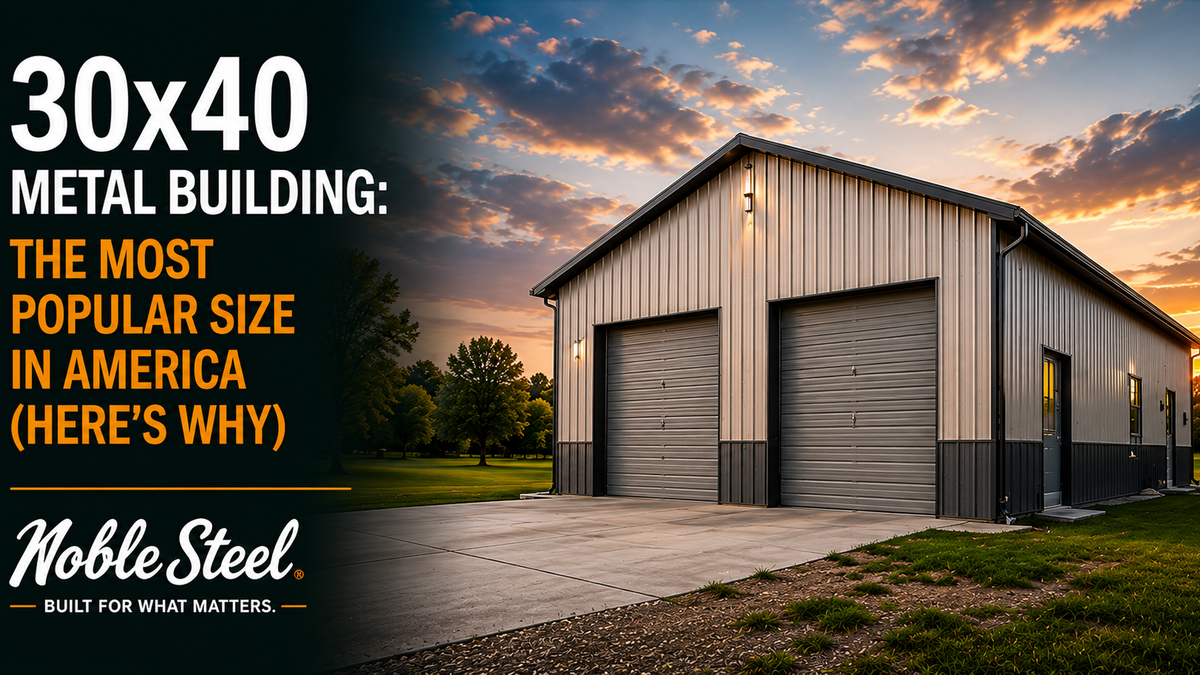
The most popular use by far. A 30x40 gives you a comfortable 2-car garage with significant room left over for a workshop, storage, or a third vehicle. Most buyers configure it with two 10x10 roll-up doors side by side on the front wall.
Workshop or Hobby Shop
Woodworkers, welders, mechanics, and hobbyists love the 30x40. It's enough space to spread out, set up dedicated work zones, and actually move around your equipment. With an insulation package, it's a year-round workspace.
Small Agricultural Storage
For smaller farming operations — hobby farms, horse properties, rural homesteads — a 30x40 handles tractor storage, hay storage, or feed and equipment. It's not a full-scale ag building, but it solves a lot of rural storage problems efficiently.
Home Business Space
Small contractors, landscapers, and tradespeople use 30x40 buildings as home base — storing tools, equipment, vehicles, and supplies. A lean-to or walled-off corner can become a small office or client meeting space.
Clearheight and Door Options
Clearheight
Standard clearheight options for a 30x40:
- 10 ft: fine for standard passenger vehicles and most storage uses
- 12 ft: the most popular choice — accommodates pickups, SUVs, most trailers, and standard equipment
- 14 ft: needed for taller trucks, boats on trailers, or if you're parking an RV
Clearheight is one of the most commonly underestimated specs. If you're on the fence, go up one size. The price difference is modest; the regret of not having enough headroom is real.
Door Configurations
The most common setup for a 30x40 residential garage:
- Two 10x10 roll-up doorson the front (gable end)
- One walk door on the side
Alternatives:
- One 12x12 doorfor vehicles that need more width
- One 10x10 + one 10x12for mixed-use (standard vehicle + taller equipment)
- Single large 20x10 openingif you're using it as an open shelter or need maximum width access
Every door addition costs money. Know what you need before you configure — it's much cheaper to get it right upfront than to cut in a door after the building is up.
Gauge, Framing, and What to Ask Before You Buy
Most 30x40 buildings use 14-gauge primary framing, which is appropriate for residential and light commercial use in most parts of the country. If you're in a high-wind area — coastal regions, tornado belt, mountain areas with heavy snow — ask what gauge is specified and whether the building is engineered to local load requirements.
Things worth asking before you buy:
1. What gauge is the primary framing?
2. Is the building engineered for my local wind and snow loads?
3. Are engineer-stamped drawings included, or extra?
4. What's the delivery radius for the price you're quoting?
5. Does the price include a concrete anchor plan?
If they can't answer all five, get a second quote.
Frequently Asked Questions About 30x40 Metal Buildings
Do I need a permit for a 30x40 metal building?
Almost certainly yes, if it has a foundation. Permit requirements vary by county and municipality, so call your local zoning office before you order anything. Some rural areas have limited oversight; most suburban and exurban counties require a full building permit, inspections, and sometimes engineer-stamped drawings.
How long does it take to get a 30x40 metal building?
Lead times run 6–12 weeks for the kit from most manufacturers in 2026, depending on demand. Factor in an additional 1–2 weeks for delivery scheduling and 1–3 weeks for installation depending on contractor availability. Plan for 3–4 months from order to move-in as a reasonable expectation.
Can I assemble a 30x40 myself?
Technically, yes. Practically, it depends on your skills and comfort level. The kit comes with an assembly manual. You'll need at least 2–3 people, basic construction tools, and a comfort level with working at height. Most buyers use a professional erection crew, especially for anything over 1,200 square feet. Getting it wrong costs more than the savings.
Does a 30x40 come with insulation?
No. Insulation is almost always an add-on. For a 30x40 workshop or garage, a standard insulation package adds $2,000–$4,500 to the kit price depending on R-value. It's worth it if you plan to spend time inside.
What's the difference between a 30x40 and a 40x60?
The 40x60 gives you 2,400 square feet versus 1,200 for the 30x40 — exactly double. The 40x60 kit typically costs $43,000–$55,000 versus $16,000–$24,000 for the 30x40. If your use case genuinely requires the extra space, the 40x60 is the right call. If you're buying extra space you won't use, the 30x40 saves you real money.
Is a 30x40 the Right Size for You?
The 30x40 is the most popular size for a reason: it solves a lot of common problems at a price that works. But it's not the right size for everyone.
Go smaller (30x30 or 24x30) if you just need basic storage and don't plan to spend significant time inside. Go bigger (30x50, 40x60) if you're running a business out of it, storing large equipment, or genuinely need the extra square footage.
The worst outcome is buying a building that's too small and regretting it six months in. The second-worst is buying more than you need and paying for space you never use. We'll help you figure out which one actually fits your situation — including talking you out of the 30x40 if something else makes more sense.
Seasonal pricing tip:Noble Steel runs promotions at certain times of the year — and the 30x40 is one of the sizes most likely to be included. If a discount window is open when you're shopping, take advantage of it. These are real price breaks, not manufactured urgency, and they close when they close.
Ready to get a real quote? Talk to Noble Steel — we'll help you find the right building or talk you out of the wrong one.